In many manufacturing environments, vibratory finishing systems are essential for achieving the required surface quality after machining or fabrication. These systems remove burrs, smooth surfaces, and prepare components for coating, assembly, or final use. Companies like Kramer Industries have long supported manufacturers with finishing solutions that help improve efficiency and consistency across production lines. While traditional vibratory finishing remains widely used, evolving production demands sometimes require faster processing and tighter finishing control. In those situations, high frequency batch finishers can offer important advantages.
Understanding when to use high frequency batch finishers versus traditional vibratory finishing helps manufacturers improve productivity, reduce finishing time, and maintain consistent part quality.
Understanding Traditional Vibratory Finishing
Traditional vibratory finishing relies on relatively low-frequency vibration combined with larger amplitude movement. Inside the finishing bowl or tub, the vibration produces a rolling motion that causes parts and media to circulate together. As the media and parts interact, burrs are gradually removed and surfaces become smoother.
This finishing process is widely used because it allows manufacturers to process large batches of components efficiently.
- Common applications of vibratory finishing include:
- Deburring machined or stamped components
- Edge radiusing and smoothing sharp edges
- Surface cleaning and preparation
- Pre-polishing before plating or coating
- One of the biggest advantages of vibratory finishing is its ability to handle large volumes of parts with minimal operator involvement. However, the main tradeoff is processing time. Depending on the required finish, cycles can sometimes take several hours to complete.
For manufacturers working with higher-value parts or tighter production schedules, these longer cycle times may limit productivity.
What Makes High Frequency Batch Finishers Different
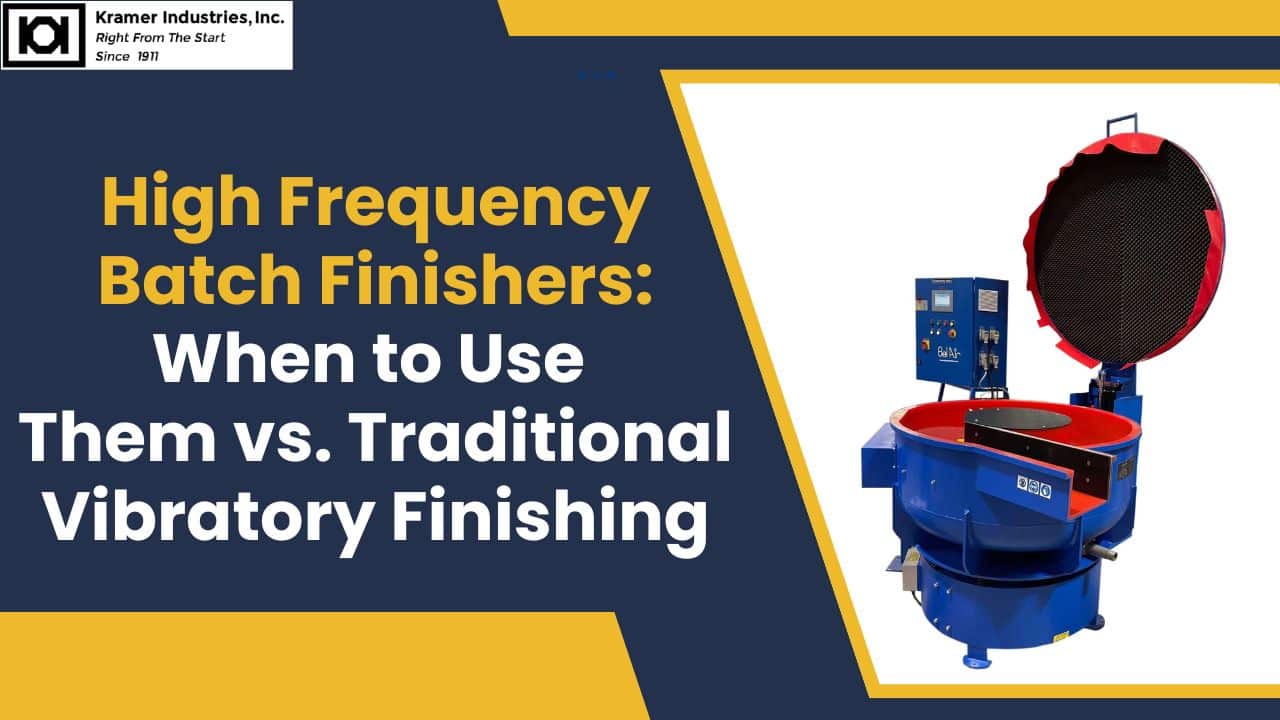
High frequency batch finishers operate on a similar principle but significantly increase the vibration frequency while reducing the amplitude of movement. This change creates a more intense and controlled interaction between the media and the parts.
Instead of the larger rolling motion seen in traditional vibratory finishing, high frequency systems produce rapid micro-movements. These small, fast impacts allow the abrasive media to interact with part surfaces more frequently.
The result provides several benefits:
- Faster finishing cycles
- Improved surface refinement
- Greater consistency across complex geometries
- Reduced risk of part-to-part collision
Because the vibration is tighter and more controlled, manufacturers can achieve higher-quality finishes with improved process control. Finishing solutions offered by Kramer Industries often incorporate these technologies to support manufacturers working with demanding surface finish requirements.
When High Frequency Finishing Is the Better Choice
While vibratory finishing works well for many applications, certain manufacturing situations benefit significantly from high frequency finishing technology.
Precision Components
Industries such as aerospace, medical device manufacturing, and advanced automotive production require extremely controlled finishing processes.
High frequency batch finishers allow manufacturers to refine surfaces while maintaining tight dimensional tolerances. This is especially valuable for precision-machined parts and complex components.
Decorative and Cosmetic Finishing
Some parts require a bright, consistent surface appearance. The rapid interaction between media and parts in high frequency systems can produce superior polishing results.
Typical examples include:
- Automotive wheel rims
- Decorative hardware components
- Consumer product metal partsThese systems help produce a more uniform surface finish across visible components
Production Environments Where Cycle Time Matters
One of the biggest advantages of high frequency batch finishers is their ability to dramatically reduce processing time.
Shorter finishing cycles can result in: - Increased production throughput
- Lower labor costs
- Faster turnaround times
Manufacturers focused on improving productivity often adopt high frequency finishing technology as part of their surface finishing strategy.
Sensitive or Thin-Walled Components
Traditional vibratory finishing sometimes creates enough part movement that delicate components may collide or deform during processing.
High frequency systems reduce this risk because the amplitude of movement is smaller and more controlled.
This makes them ideal for:
- Lightweight components
- Thin-walled parts
- Parts with delicate features
The controlled motion helps protect parts while still achieving effective surface finishing.
Where Traditional Vibratory Finishing Still Excels
Despite the advantages of high frequency finishing, traditional vibratory finishing remains a critical part of many finishing operations.
It is often the better choice when:
- Large batches of parts must be processed economically
- Surface finishing requirements are moderate
- Longer finishing cycles are acceptable
- Parts are durable and not sensitive to movement
In many manufacturing facilities, both technologies are used together. Traditional vibratory finishing handles bulk processing while high frequency batch finishers are used for precision finishing or high-value parts. Surface finishing systems from Kramer Industries help manufacturers implement these complementary processes to improve overall efficiency.
Improving Finishing Efficiency
Selecting the right finishing technology depends on several factors, including part geometry, surface requirements, production volume, and desired cycle time.
High frequency batch finishers provide manufacturers with a powerful option for solving finishing challenges that traditional vibratory finishing may not address efficiently. By accelerating finishing cycles and delivering more controlled surface interaction, these systems help improve both productivity and part quality.
Conclusion
Traditional vibratory finishing continues to be one of the most reliable and widely used finishing processes in manufacturing. It offers an economical solution for processing large volumes of parts while delivering consistent results. However, when faster cycle times, improved surface quality, and tighter finishing control are required, high frequency batch finishers provide clear advantages. Their rapid vibration and controlled motion allow manufacturers to achieve superior finishing results while protecting delicate components.
Manufacturers looking to improve finishing performance can work with Kramer Industries to evaluate vibratory finishing and high frequency batch finishing solutions that match their production needs and production goals.
Related Articles