HFB Series – High Frequency Batch Finishers
The DB Series is ideal for shorter cycle times and for those new to mass finishing. Two different sizes are available for large and small batch sizes. Economical and durable, the DB Series are one of our most popular vibratory tumblers.
HFB Series High Frequency Batch Finishers | High Energy Finishing Machine for Precision Surface Refinement
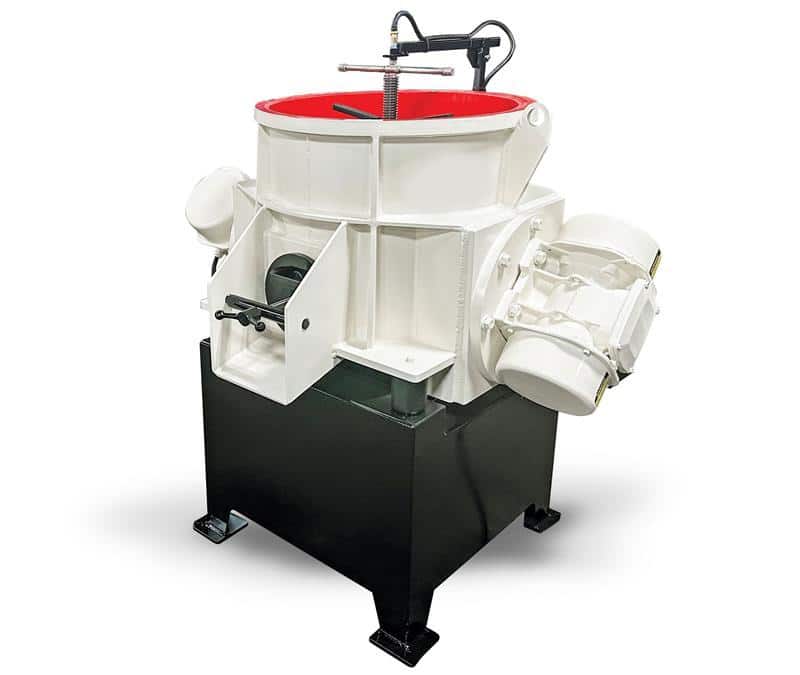
Kramer Industries HFB Series High Frequency Batch Finishers are engineered for precision surface refinement, low Ra finishing, and mirror-like polishing of complex, high-value components. The HFB Series is designed for applications where traditional finishing machines and conventional vibratory systems may not provide the required level of surface control. As a High Energy Finishing Machine, it uses high-frequency, low-amplitude lapping action to produce consistent, repeatable, and isotropic surface finishes.
The process is suited to automotive and performance wheel rims, aerospace blisks, bearing races, wind turbine shafts and pinions, forging mold refurbishment, medical devices, and other high-value or delicate components. A High Frequency Wheel Finisher can provide complete media contact across complex contours while reducing directional finishing effects and protecting critical edges.
Optimized Floor Space | Labor Efficiencies | Improved Quality
The HFB Series uses a compact processing chamber and controlled high-frequency motion to deliver strong finishing action without requiring the larger footprint associated with some conventional systems. This High Energy Finishing Machine can support shorter processing cycles while maintaining controlled media movement and repeatable results.
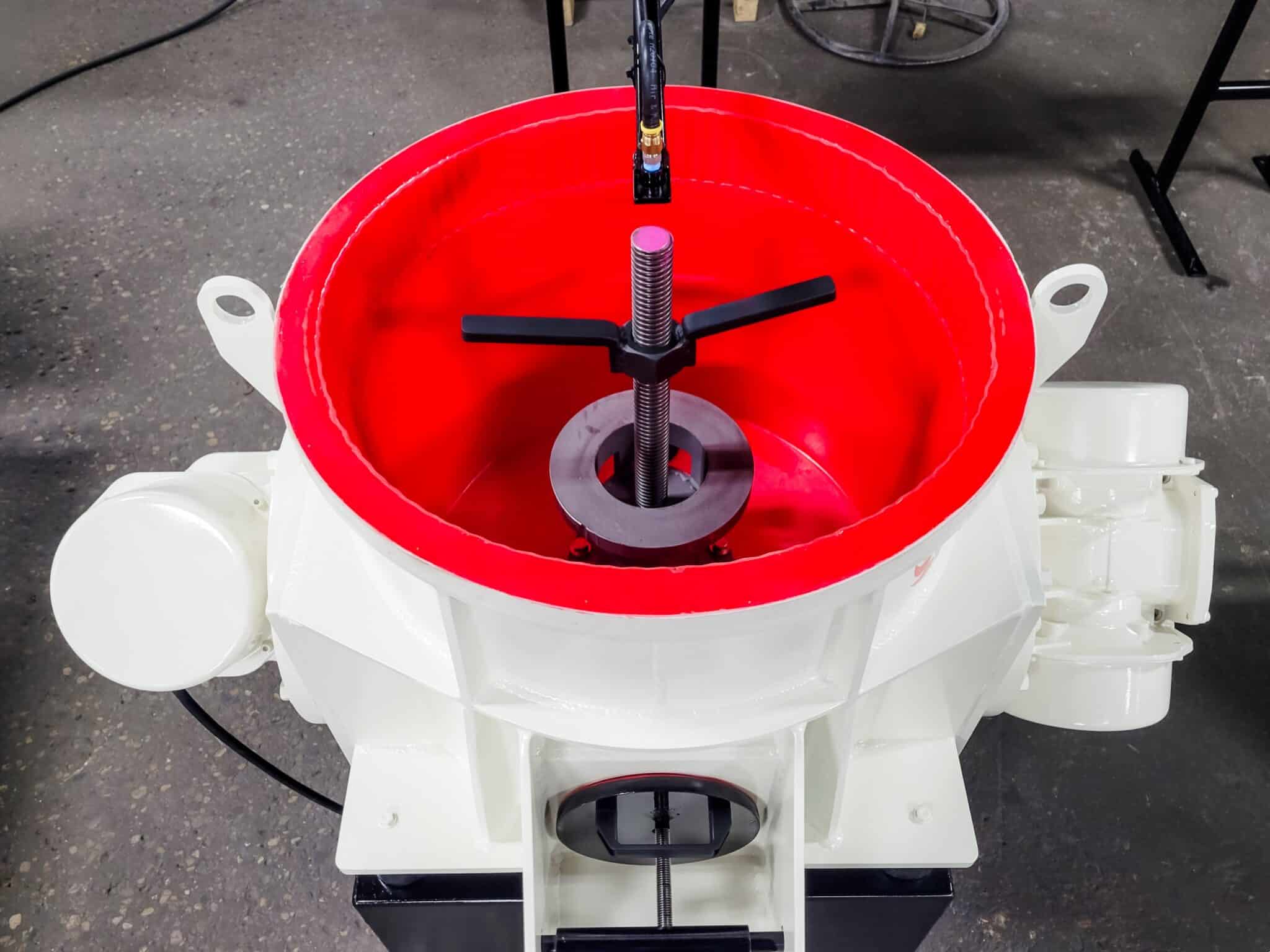
Unlike conventional vibratory systems that rely heavily on amplitude and part-to-part interaction, HFB machines fixture parts securely within the work chamber. This reduces impingement and allows finishing media to contact the part surfaces more uniformly. The result is improved surface refinement without unwanted directional patterns, shadowing, or leading-edge effects.
For wheel manufacturers, a High Frequency Wheel Finisher can process complex rim contours, including spokes and intricate design features, while maintaining consistent surface coverage. The same process can be adapted to aerospace blisks and other components where surface integrity and repeatability are important.
How the HFB Process Works
The HFB Series generates motion through high frequency and controlled low amplitude to create a true lapping-style action. Two indexable vibratory motors are mounted on adjustable indexing plates, allowing operators to change the orientation of amplitude and fine-tune media flow.
The media motion inside the chamber is isotropic, helping eliminate directional finishing problems and improving access to internal surfaces that conventional vibratory systems may not process effectively. Adjustable motor weights allow the finishing aggression to be modified, while dual variable frequency drives provide control over operating frequency.
Precision fixturing keeps components securely positioned during processing. This combination of controlled motion, adjustable frequency, and fixturing makes the High Energy Finishing Machine suitable for applications ranging from aggressive refinement to ultra-fine polishing.
Applications
The HFB Series is especially suited for:
- Automotive and performance wheel rims
- Aerospace blisks and bladed disks
- Bearing races
- Wind turbine shafts and pinions
- Forging mold refurbishment
- Medical devices
- High-value and delicate components requiring precise finishing
For applications involving wheel rims, the High Frequency Wheel Finisher provides controlled media movement across complex surfaces. For aerospace and medical components, the process can help achieve consistent surface refinement while limiting unwanted contact between components.
Construction and Design
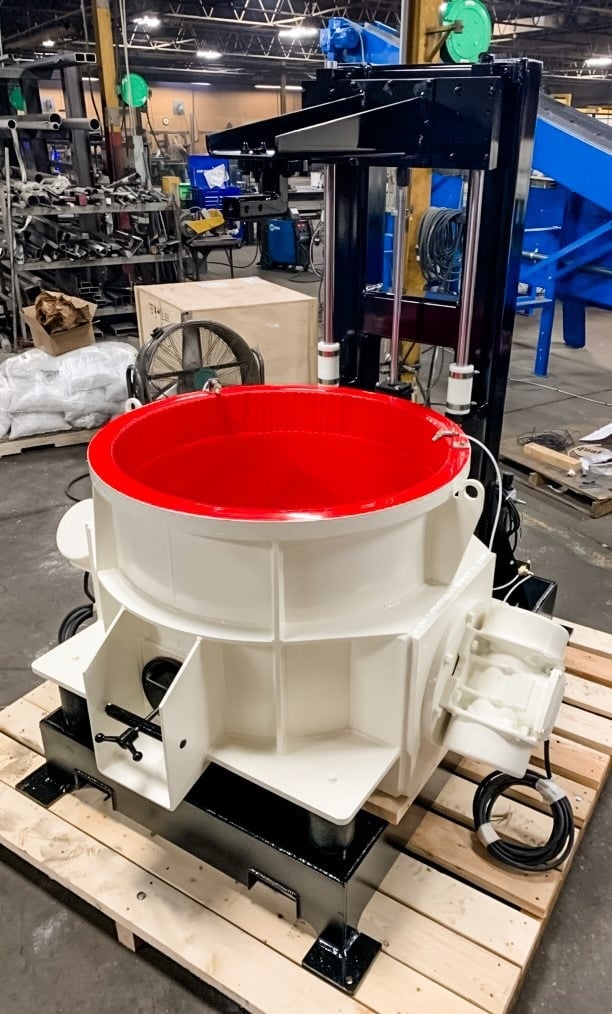
HFB finishers feature a heavy-duty, interlocking structural design forming a cylindrical processing chamber. Each unit includes:
- Premium polyurethane lining
- Integrated drain system
- Vibration isolators and rigid base frame
- High-efficiency vibratory motors
- Adjustable weight system for process tuning
The integrated vibration isolators improve operational stability and energy transfer efficiency. The compact footprint also helps maximize production capacity while conserving valuable floor space.
The controlled low-amplitude process makes this system useful where surface quality is more important than aggressive bulk material removal. The equipment can be configured around the finishing requirements of the component, media, cycle, and desired surface result.
Key Advantages
- Greater force and energy transmission than standard vibratory systems
- Significantly shorter cycle times compared to conventional finishing machines
- Ideal for high-value parts requiring mirror finishes, including wheel rims and blisks
- Gentle, controlled process suitable for sensitive components
- Complete part coverage and repeatability
- Improved part quality with reduced manual labor
By automating processes that were traditionally performed by hand, the HFB Series can improve consistency while reducing labor costs, variability, and rework. The HFB system provides a controlled finishing process for manufacturers that require high polish levels and repeatable surface results.
Surface Finishing Capabilities
The HFB process can be used for precision polishing, surface refinement, and low-Ra finishing where a uniform surface is required. Its isotropic media motion helps distribute finishing action across the component rather than creating a directional pattern.
This makes the process useful for parts with complex contours, internal geometries, and sensitive surfaces. A High Frequency Wheel Finisher can help maintain consistent coverage across wheel spokes and other difficult-to-reach areas while minimizing edge rounding or distortion.
The HFB process can also reduce the need for manual polishing on suitable applications. By holding parts securely and controlling the finishing environment, the system provides a repeatable approach to surface refinement.
Process Control and Flexibility
Operators can adjust the process through variable frequency drives, adjustable motor weights, and indexable motor positioning. These controls allow finishing conditions to be tuned for different materials, part geometries, media types, and surface requirements.
This flexibility is important when one finishing cell needs to handle multiple components. The process can be adjusted from more aggressive refinement to fine polishing without changing the basic equipment platform.
Kramer Industries can support equipment configuration and process development around the part geometry, desired finish, media selection, and production requirements. Application testing can also help establish appropriate process conditions before production implementation.
When to Choose the HFB Series
The HFB Series may be appropriate when a finishing process requires:
- Low-Ra or mirror-like surface refinement
- Isotropic finishing
- Controlled finishing of complex geometries
- Protection of delicate or high-value components
- Reduced manual polishing
- Shorter cycle times
- Consistent surface coverage
- Compact equipment footprint
A High Energy Finishing Machine is particularly relevant when conventional vibratory finishing does not provide sufficient control over surface direction, part positioning, or finishing intensity.
Kramer Industries can help evaluate whether the HFB process fits the part geometry, surface requirement, and production environment. Kramer Industries also supports application-focused process development.
HFB Series Specifications
HFB Series Specifications |
|||||
|---|---|---|---|---|---|
Model |
Inside Diameter |
Inside Depth |
Cu. Ft. Capacity |
Machine Height |
Media Discharge Height |
HFB-240 |
24” | 19.5” | 4.8 | 48.5” | 24” |
HFB-300 |
30” | 23.5” | 9.4 | 52.5” | 24” |
HFB-360 |
36” | 25” | 14.5 | 58” | 28” |
HFB-480 |
48” | 30” | 31 | 69” | 34” |
HFB-600 |
60” | 36” | 57 | 82” | 40” |
Why Choose the HFB Series?
If you are finishing high-value parts where surface quality, repeatability, and process control are critical, the HFB Series delivers measurable advantages over conventional vibratory systems or other finishing machines.
For wheel manufacturers seeking a consistent mirror polish across complex rim designs, or aerospace manufacturers refining critical blisk surfaces, HFB machines provide the precision, energy, and control required within advanced vibratory systems.
Shorter cycle times. Higher polish levels. Better surface consistency. Smaller footprint.
For manufacturers focused on precision and efficiency, the HFB Series delivers a controlled, high-energy vibratory finishing machine solution built to elevate finishing performance.
HFB-240 High Frequency Finisher
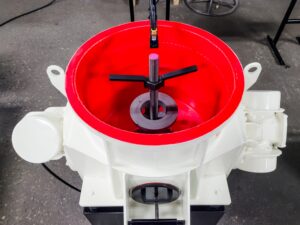
HFB-240 Wheel Fixture
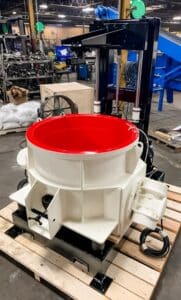
HFB-360 with Plunger-Front
Frequently Asked Questions (FAQs)
1. What are the two main types of surface finishes?
Surface finishes are commonly discussed as rougher or smoother surface conditions, but the exact classification depends on the industry, measurement method, and application. Finishing processes can be selected to achieve a specified roughness, appearance, or functional surface condition.
2. What are the three types of finishing?
Three broad finishing approaches can include abrasive finishing, polishing, and surface treatment, although terminology varies by industry. The appropriate process depends on the material, part geometry, required surface condition, and production requirements.
3. What are the three main types of metal finishing processes?
Common groups include mechanical finishing, chemical or electrochemical finishing, and coating or plating processes. Within mechanical finishing, operations such as deburring, grinding, polishing, and vibratory finishing are used for different surface requirements.
4. What is a High Frequency Wheel Finisher used for?
A High Frequency Wheel Finisher is used for controlled polishing and surface refinement of wheel rims and other complex components. The HFB process provides uniform media contact while helping reduce directional finishing effects and edge distortion.
5. What is hfb?
If you are asking what is hfb in surface finishing, HFB refers to High Frequency Batch Finishing. The HFB Series uses high-frequency, low-amplitude motion and precision fixturing to provide controlled, repeatable surface refinement for complex and high-value components. This High Energy Finishing Machine is designed for applications where consistent surface quality is important.
Related Products
-

Liquid Burnishing Compounds
Price range: $39.95 through $139.75 Learn More The range of Liquid Finishing Compounds for mass finishing are used in all types of tumbling. All are pH balanced and concentrated for optimal performance. Safe to use with all tumbling media types.
 -

MB Series – Heavy-Duty Grade, Mini-Bowl Style, Vibratory
$729.00 Learn MoreThe MB Series is ideal for shorter cycle times and small batch runs. Economical and durable, the MB Series are great ?starter? systems for those looking to get into mass finishing or need a unit for scale-up testing. Some systems can be upgraded for use with steel tumbling media.
-

EV Series – Heavy-Duty Grade, Tub-Style, Floor Model, Vibratory Tumbler
$12,995.00 Learn MoreThe EV Series is engineered for production environments and heavy usage. Multiple sizes are available with customizable sizes commonly manufactured. One of the most heavy duty vibratory systems available. -

Plastic Tumbling Media
$3.27 Learn MorePlastic Tumbling Media is recommended for general purpose metal removal, pre-plate finishing, and moderate cutting. Plastic Tumbling Media is ideal for soft metals such as brass and aluminum or for stringy materials to avoid rolling the burr into a hole.