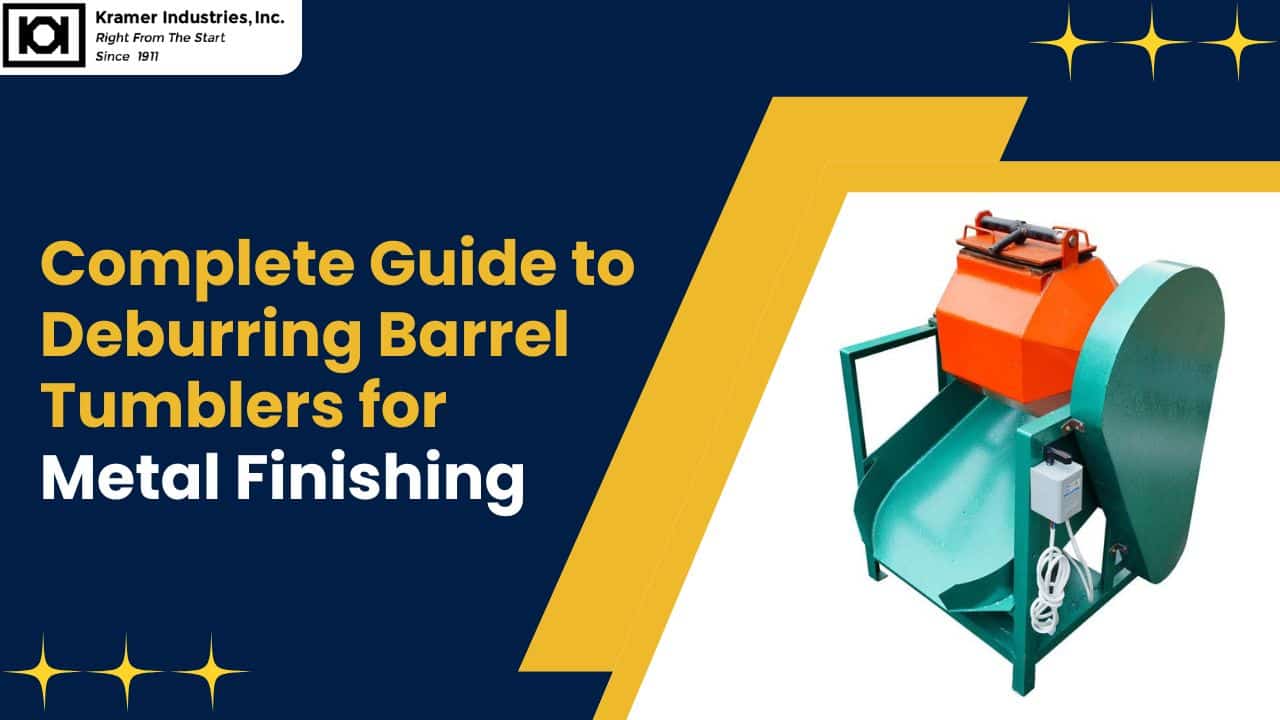
In metalworking and manufacturing operations, even the most precisely machined components often require additional finishing before they are ready for assembly or shipment. Burrs, sharp edges, and surface imperfections can impact product quality, safety, and performance. At Kramer Industries, we understand that efficient deburring is a critical step in achieving consistent finishing results. For high-volume production environments, deburring barrel tumblers continue to be one of the most reliable and cost-effective solutions available.
By automating the deburring process and allowing large quantities of parts to be processed simultaneously, barrel tumbling helps manufacturers improve productivity while maintaining consistent surface quality. Whether used for machined parts, stampings, castings, or fabricated components, barrel tumblers remain a proven finishing method across a wide range of industries.
What Are Deburring Barrel Tumblers?
Barrel tumbling is a mechanical finishing process that uses a rotating drum to create controlled friction between parts, abrasive media, water, and finishing compounds. As the barrel rotates, the contents continuously cascade and interact, gradually removing burrs, smoothing edges, and refining surface finishes.
Unlike manual deburring methods that require significant labor and operator involvement, deburring barrel tumblers process multiple parts at once with minimal supervision. This makes them especially valuable for manufacturers handling medium to large production volumes.
The process can be adapted for various metals and finishing requirements by adjusting media selection, processing time, barrel speed, and compound usage.
How the Deburring Process Works
The effectiveness of barrel tumbling comes from the repeated contact between parts and finishing media. As the barrel rotates, components are lifted and allowed to tumble back through the media, creating thousands of controlled abrasive interactions.
Several factors influence the performance of deburring barrel tumblers:
- Type of tumbling media
- Media size and shape
- Barrel rotational speed
- Material hardness
- Part geometry
- Media-to-part ratio
- Processing duration
- Compound selection
Each variable affects both the speed of burr removal and the final surface finish. Proper process optimization helps manufacturers achieve consistent results while minimizing cycle times.
Why Deburring Is Essential
Burrs may appear insignificant, but they can create serious challenges throughout the manufacturing process. Sharp edges can interfere with assembly, damage mating components, affect coating adhesion, and create safety hazards for workers handling finished products.
Proper deburring helps manufacturers:
- Improve product quality
- Reduce assembly issues
- Enhance workplace safety
- Improve coating performance
- Increase dimensional consistency
- Create a more professional appearance
By incorporating deburring barrel tumblers into production workflows, manufacturers can standardize finishing operations and reduce reliance on labor-intensive manual methods.
Advantages of Barrel Tumbling for Metal Finishing
Barrel tumbling remains a popular finishing method because it offers multiple operational advantages.
High-Volume Processing
One of the biggest benefits of barrel tumbling is its ability to process large quantities of parts in a single batch. Hundreds or even thousands of components can often be finished simultaneously, significantly increasing throughput.
Consistent Results
Manual finishing can vary from operator to operator. Barrel tumbling creates a repeatable process that delivers uniform edge refinement and surface quality across production runs.
Reduced Labor Requirements
Because the process is largely automated, manufacturers can reduce the labor associated with hand deburring while maintaining consistent output.
Surface Improvement
In addition to removing burrs, barrel tumbling helps smooth machining marks, blend surface irregularities, and improve overall appearance. This is especially valuable when preparing parts for plating, painting, or coating.
Cost Efficiency
The ability to process large batches while reusing media and compounds makes barrel tumbling an economical finishing solution for many manufacturing operations.
Selecting the Right Tumbling Media
Media selection plays a critical role in determining the effectiveness of deburring barrel tumblers. Different media types provide varying levels of cutting action and surface refinement.
Ceramic Media
Ceramic media offers aggressive cutting performance and is commonly used for removing heavier burrs on steel, stainless steel, and other hard metals. Its durability makes it a popular choice for demanding industrial applications.
Plastic Media
Plastic media provides a gentler cutting action and is often used for softer metals such as aluminum, brass, and zinc. It helps reduce part damage while still delivering effective deburring performance.
Steel Media
Steel media is primarily used for burnishing and polishing operations rather than aggressive burr removal. It produces bright, smooth finishes on many metal surfaces.
Organic Media
Materials such as corn cob and walnut shell are typically used during polishing and drying operations after primary deburring has been completed.
Choosing the proper media allows manufacturers to balance processing speed, finish quality, and production efficiency.
Applications Across Industries
The versatility of deburring barrel tumblers makes them valuable across many manufacturing sectors.
Common applications include:
- Deburring machined components
- Finishing laser-cut parts
- Cleaning castings
- Smoothing stamped metal products
- Preparing surfaces for plating
- Polishing hardware and fasteners
- Refining consumer product components
Industries such as automotive, aerospace, medical device manufacturing, electronics, industrial equipment, and metal fabrication all rely on barrel tumbling to achieve consistent finishing standards.
Optimizing Tumbling Performance
Achieving the best results requires ongoing process control and monitoring. Manufacturers should regularly evaluate operating conditions to maintain consistency and maximize productivity.
Key process considerations include:
- Monitoring media wear
- Maintaining proper compound concentration
- Controlling load size
- Optimizing cycle times
- Inspecting finished parts regularly
- Adjusting media formulations when necessary
Small process improvements can often lead to significant gains in throughput, finish quality, and operating efficiency.
Consistency is especially important in high-volume manufacturing environments where even minor variations can impact downstream operations.
At Kramer Industries, we help manufacturers identify the right tumbling media, compounds, and process parameters to achieve reliable deburring and surface finishing results. A properly configured barrel tumbling process not only improves product quality but also supports greater operational efficiency across the production floor.
Conclusion
Deburring remains a critical part of producing high-quality metal components, and deburring barrel tumblers continue to be one of the most effective solutions for large-scale finishing operations. By combining controlled mechanical action with properly selected media and compounds, these systems remove burrs, smooth surfaces, and improve overall product quality with minimal labor involvement.
When optimized correctly, deburring barrel tumblers provide manufacturers with consistent finishes, increased productivity, and lower operating costs. To learn more about tumbling media, finishing compounds, and industrial deburring solutions, contact Kramer Industries today.
Related Articles