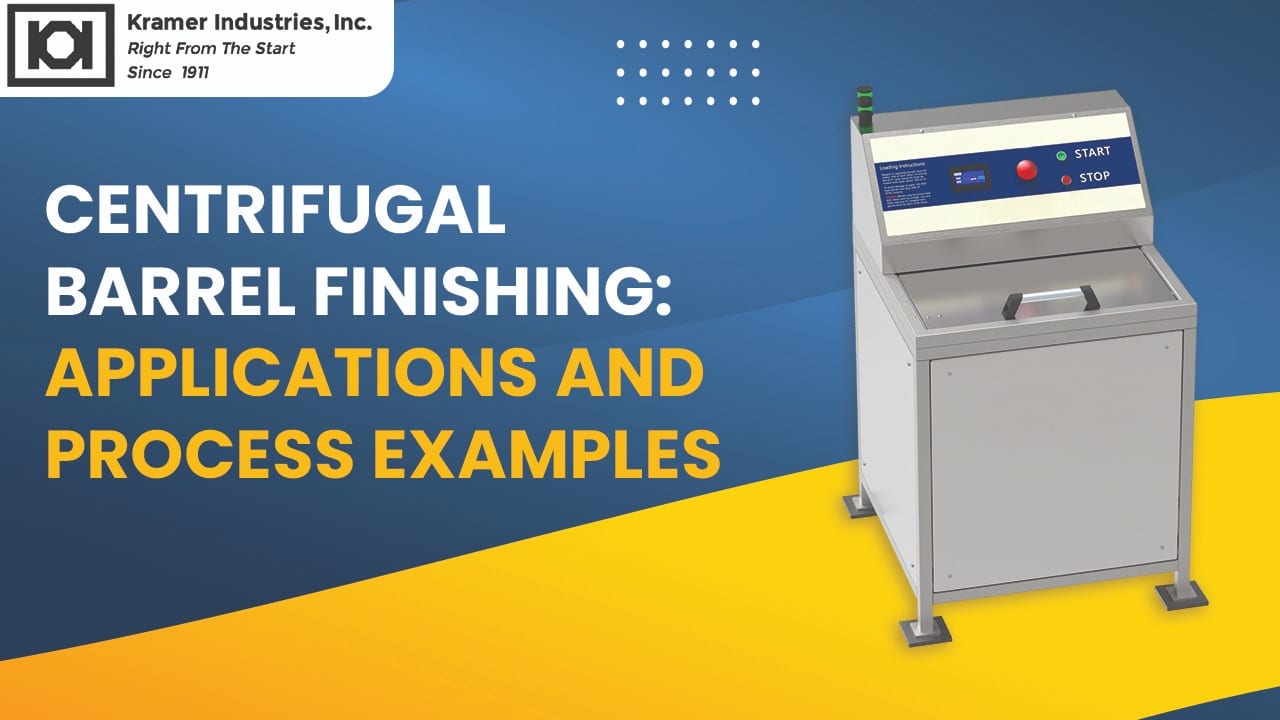
Centrifugal barrel finishing is widely used when manufacturers need fast, controlled material removal and highly repeatable finishes on precision components. The high-energy motion generated inside the barrels allows parts to be deburred, radiused, polished, or smoothed much faster than with conventional vibratory finishing. Because barrels can be compartmentalized, delicate or high-value parts can often be processed without part-to-part contact.
Below are common applications and examples of how HBF Series systems are used in real production environments.
Precision Machined Components
Machined parts often require burr removal and controlled edge radiusing after milling, turning, or grinding operations. Centrifugal barrel finishing provides a highly repeatable method for removing sharp edges while maintaining dimensional integrity.
Typical processes include:
- Removing machining burrs from milled or turned parts
- Edge radiusing to meet engineering specifications
- Surface smoothing prior to coating or plating
- Preparing parts for assembly operations
Common parts processed include fittings, fasteners, housings, valves, and precision machined components used in aerospace, medical, and automotive applications.
Medical and Dental Components
Medical device manufacturers often require extremely consistent finishes along with strict control of edge radiusing and surface quality. The HBF Series allows manufacturers to finish small and complex parts while maintaining tight tolerances.
Typical finishing processes include:
- Edge radiusing of surgical instruments
- Surface smoothing of implant components
- Polishing dental and orthodontic devices
- Finishing titanium, stainless steel, and cobalt alloys
Barrel compartmenting allows sensitive components to be processed individually, reducing the risk of part-to-part damage.
Aerospace Components
Aerospace manufacturers frequently require burr-free edges and smooth surfaces to improve part performance and reliability. Centrifugal barrel finishing delivers controlled material removal while maintaining uniformity across large batches of precision parts.
Applications often include:
- Deburring turbine and engine components
- Edge radiusing of machined aerospace hardware
- Surface smoothing of high-precision components
- Removing micro-burrs from complex geometries
The high-energy finishing action helps achieve consistent results even on difficult-to-machine materials.
Additive Manufacturing Post-Processing
Parts produced through additive manufacturing often require post-processing to improve surface finish and remove support artifacts. Centrifugal barrel finishing can rapidly smooth surfaces and refine part geometry.
Common applications include:
- Surface smoothing of metal 3D printed components
- Removal of small support remnants
- Preparing parts for coating or plating
- Improving cosmetic appearance and tactile feel
Because the process is highly controllable, manufacturers can refine surface finishes without excessive material removal.
Jewelry and Decorative Metal Finishing
High-energy finishing is frequently used in jewelry manufacturing to produce smooth surfaces and bright finishes on small components.
Typical processes include:
- Pre-polishing prior to final buffing
- Burnishing precious metal components
- Surface smoothing on intricate parts
- Deburring cast jewelry components
The ability to process multiple batches simultaneously helps increase productivity for high-volume production environments.
Automotive and Small Mechanical Components
Automotive manufacturers often require high throughput finishing for precision parts such as gears, connectors, and machined fittings. Centrifugal barrel finishing can dramatically reduce finishing cycle times while maintaining consistent quality.
Typical applications include:
- Deburring transmission and engine components
- Edge radiusing on stamped or machined parts
- Surface preparation before coating or plating
- Finishing small mechanical assemblies
Short cycle times allow manufacturers to increase throughput without expanding floor space.
Electronics and Connector Components
Small electrical connectors and electronic components often require burr-free edges and smooth surfaces to ensure reliable electrical contact and assembly performance.
Typical finishing processes include:
- Deburring precision connector components
- Smoothing stamped metal parts
- Surface preparation before plating
- Cleaning and polishing small conductive components
The high-energy process ensures consistent results across large volumes of small parts.
Why Manufacturers Choose the HBF Series Centrifugal Barrel Finishers
Across these applications, centrifugal barrel finishing offers several key advantages:
- Faster finishing cycles compared to vibratory systems
- Consistent edge radiusing and burr removal
- Ability to isolate parts during processing
- Repeatable results for precision components
- Increased production throughput
For manufacturers producing high-value or high-precision parts, these advantages often translate into improved product quality and more efficient finishing operations.
Conclusion
Related Articles