Removing paint from an aircraft component sounds straightforward until you consider what is underneath the coating. Aluminum skins, precision components, composite materials, and other sensitive substrates can be damaged by an abrasive that is too aggressive. The goal is not simply to remove the coating. It is to remove it efficiently while preserving the dimensions, surface characteristics, and integrity of the underlying part.
That balance is where acrylic plastic grit has earned an important role in abrasive blasting.
At Kramer Industries, acrylic plastic grit can be considered when coating removal requires controlled abrasive action and careful protection of the underlying aircraft component.
Why Acrylic Plastic Grit Works on Sensitive Components
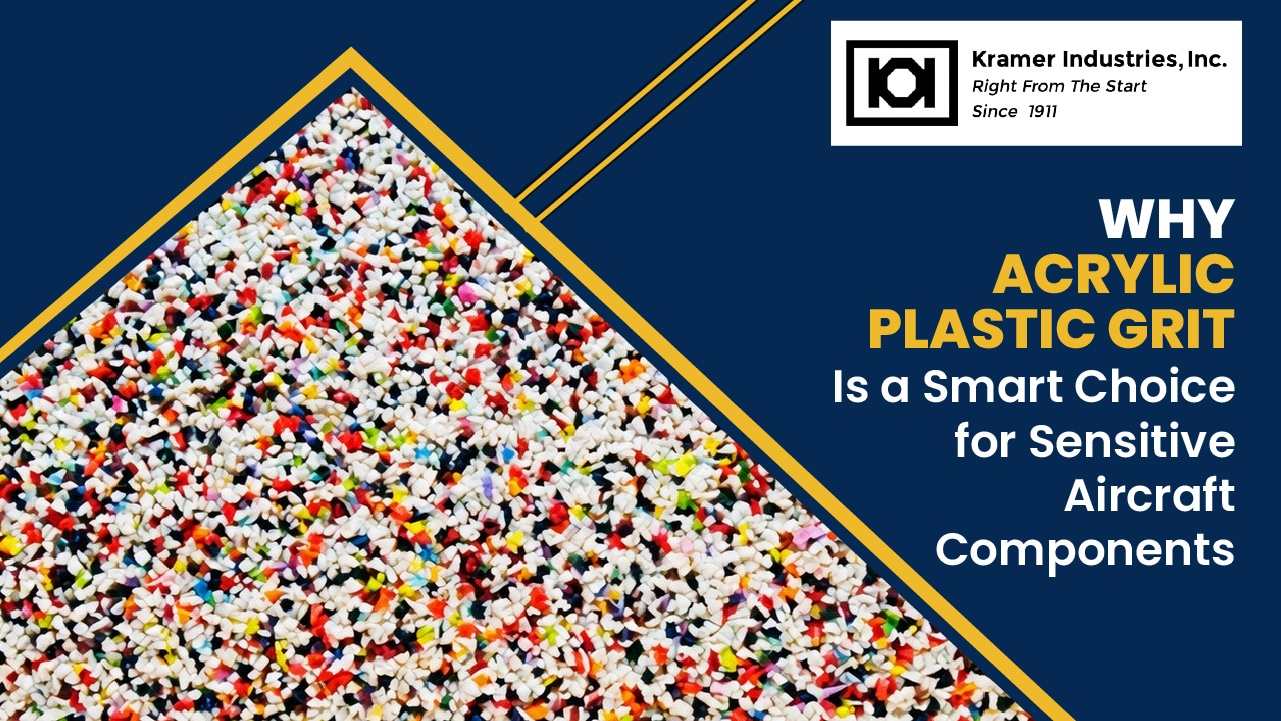
Acrylic plastic grit is a relatively lightweight, nonmetallic blasting abrasive designed for applications where surface protection is critical. Unlike harder mineral abrasives that aggressively cut into a surface, acrylic plastic media removes coatings with less risk of unnecessarily altering the substrate.
This characteristic can be especially valuable when stripping paint and coatings from aluminum and other sensitive aircraft components. Excessive surface profiling, dimensional changes, or unnecessary material removal can turn a successful stripping operation into a damaged part.
Acrylic plastic grit provides controlled cleaning action. The particles impact the coating and help break its bond with the substrate without producing the same cutting action associated with harder abrasives such as aluminum oxide.
For the operator, that means greater control. For the company doing the work, it can mean:
- Fewer damaged components
- Less rework
- More consistent coating removal
- Better control over the finished surface
- A more repeatable stripping process
Choosing the Right Acrylic Plastic Grit Size
Media selection does not stop with choosing acrylic plastic grit. Particle size also affects how the blasting process performs.
Larger particles generally deliver greater impact energy. They can be useful when removing thicker or more stubborn coatings, but they may produce a more aggressive blasting action. Finer particles provide more impacts across the surface and can offer greater control when working with thinner coatings, detailed parts, or particularly sensitive substrates.
The correct grit size therefore depends on several variables:
- Coating thickness
- Coating type
- Substrate material
- Part geometry
- Blast pressure
- Nozzle distance
- Required surface condition after stripping
A common mistake is to assume that faster coating removal automatically means a better process. An aggressive combination of coarse media and high blast pressure may increase stripping speed, but that advantage disappears quickly if the substrate is damaged.
The better approach is to select the least aggressive combination that removes the coating at an acceptable production rate.
Testing on a representative part or sample can help establish the proper balance of grit size, air pressure, nozzle distance, and dwell time before full production begins.
How Acrylic Differs From Other Plastic Blasting Media
Not all plastic blasting media behave the same way. Acrylic is one of several plastic media types used for coating removal and surface cleaning. Other common options include urea and melamine plastic grit.
The primary difference is aggressiveness.
Acrylic plastic grit is generally selected when gentle stripping action and substrate protection are important. Urea plastic grit provides a more aggressive cutting action and can be useful when faster coating removal is required and the substrate can tolerate additional impact. Melamine plastic grit is harder and more aggressive still, making it appropriate for applications requiring stronger cutting performance.
Plastic abrasive grit can therefore be viewed as part of a broader range of media options, with different formulations offering different levels of cutting action and surface impact.
Moving toward harder plastic media can increase stripping capability, but it can also increase the potential for changing the underlying surface.
This is why selecting plastic abrasive grit based solely on the fact that it is “plastic” can be misleading. The specific resin type, particle size, blast pressure, and application requirements all influence the finished result.
Acrylic Plastic Grit for Aircraft Surface Preparation
Aircraft surface preparation requires careful control because the component being cleaned may have tight dimensional requirements or sensitive surface characteristics.
Acrylic plastic grit can be useful when the objective is to remove paint or other coatings while minimizing unnecessary changes to the substrate. This makes the choice of abrasive particularly important for applications involving:
- Aluminum aircraft components
- Thin-gauge metal parts
- Composite materials
- Detailed or precision components
- Surfaces where aggressive profiling is undesirable
The abrasive alone does not determine the outcome. The blasting process must also be controlled to prevent excessive impact or prolonged exposure in one area.
For aircraft surface preparation, the goal should always be controlled coating removal rather than simply achieving the fastest possible stripping rate.
Getting Better Results With Acrylic Plastic Grit
Successful acrylic plastic grit blasting depends on controlling the entire process. Start with the substrate and coating rather than the blast machine. Determine what must be removed, what must remain untouched, and what surface condition is acceptable when the job is finished.
From there, establish the appropriate media size and begin with conservative blasting parameters. Pressure can be adjusted gradually until an effective stripping rate is achieved.
Consistent nozzle movement is also important because excessive dwell time in one location can concentrate impact energy unnecessarily.
For a controlled process, pay attention to:
- Media size
- Air pressure
- Nozzle distance
- Nozzle movement
- Dwell time
- Coating thickness
- Condition of the substrate
For repeat production work, documenting these parameters creates a repeatable process instead of relying on operator judgment alone.
At Kramer Industries, understanding the relationship between abrasive selection, substrate sensitivity, and blasting parameters can help users establish a more controlled approach to plastic media blasting.
Conclusion
Acrylic plastic grit is valuable because it solves a difficult abrasive blasting problem: removing paint and coatings without unnecessarily attacking the surface underneath.
For sensitive aircraft components and other applications where substrate preservation matters, acrylic media can provide a controlled alternative to harder abrasives.
Choosing the correct grit size and matching it with appropriate blast pressure and technique allows operators to improve coating removal while reducing the risk of surface damage.
The objective is not to use the most aggressive abrasive that will do the job. It is to use the least aggressive process that will do the job efficiently and consistently. That is where acrylic plastic grit can provide its greatest advantage.
Kramer Industries can help users evaluate abrasive options based on the substrate, coating, desired stripping performance, and surface requirements, helping create a blasting process that balances productivity with substrate protection.
Frequently Asked Questions
1. Why is acrylic plastic grit used for aircraft components?
Acrylic plastic grit is used for aircraft components because it provides controlled coating removal while helping minimize unnecessary changes to the underlying substrate. This makes it useful for sensitive materials and components where aggressive abrasive action could cause unwanted surface alteration.
2. How do I choose the right acrylic plastic grit size for aircraft surface preparation?
Choose the grit size based on the coating thickness and type, substrate material, component geometry, required surface condition, and blasting parameters. Coarser media can provide greater impact for stubborn coatings, while finer media can offer more controlled action on thinner coatings and sensitive components.
3. Is acrylic plastic grit better than mineral abrasives for sensitive aircraft components?
Acrylic plastic grit can be a better choice when the primary requirement is coating removal with reduced risk of aggressive substrate alteration. Hard mineral abrasives such as aluminum oxide provide stronger cutting action, which may be unnecessary for sensitive aircraft components where surface preservation is important.
4. What is the difference between acrylic, urea, and melamine plastic blasting media?
Acrylic, urea, and melamine plastic media differ primarily in their hardness and aggressiveness. Acrylic is generally selected for lower-impact stripping, urea provides a moderate level of cutting action, and melamine offers more aggressive performance for applications involving tougher coatings and more durable substrates.
5. What should you consider when choosing plastic abrasive grit for aircraft surface preparation?
The main considerations are the aircraft component material, coating type and thickness, desired stripping rate, surface sensitivity, and required final surface condition. Plastic abrasive grit should be matched with appropriate blast pressure, nozzle distance, and dwell time to remove the coating without unnecessarily affecting the substrate. Kramer Industries offers abrasive media options that can be evaluated based on these application requirements.
Related Articles