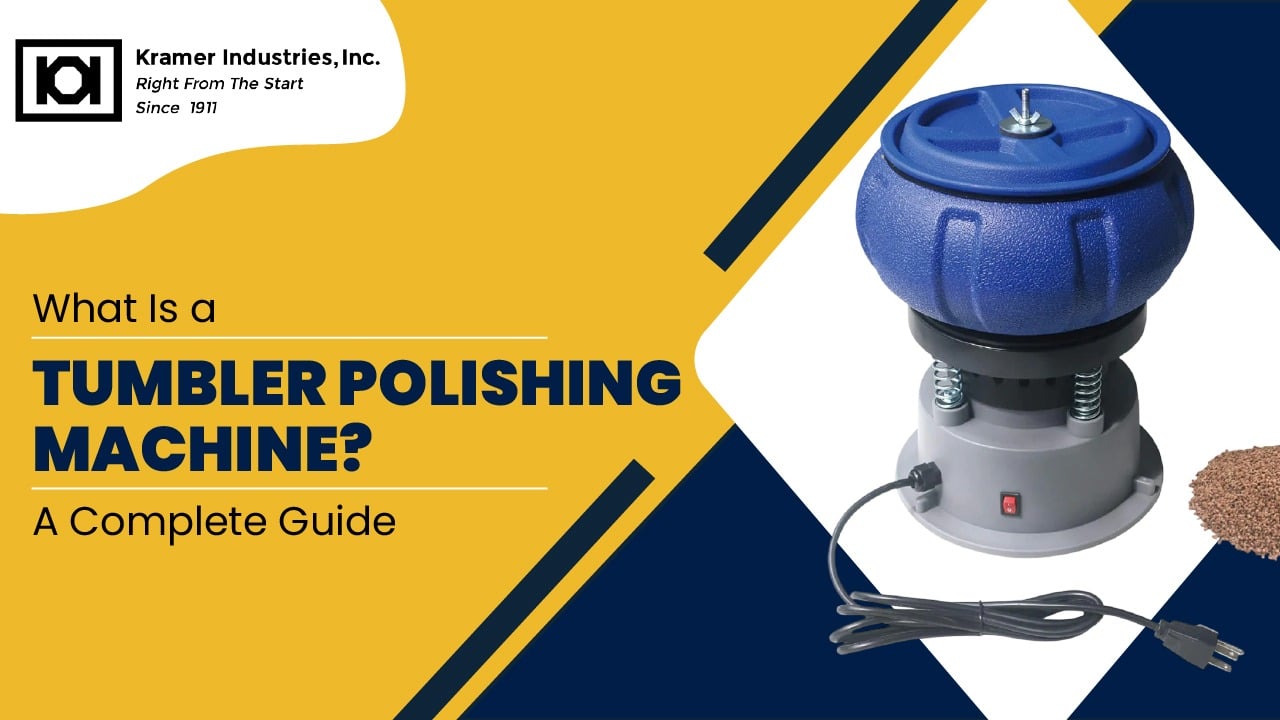
A rough metal part often begins its manufacturing journey with machining marks, sharp edges, burrs, or surface imperfections that can affect both appearance and performance. Before these components are assembled, coated, plated, or shipped, they typically undergo a finishing process to improve their surface quality. At Kramer Industries, we know that selecting the right finishing equipment is essential for achieving consistent results while improving production efficiency. One of the most effective solutions for high-volume finishing is a tumbler polishing machine.
A tumbler polishing machine is designed to automate surface finishing by processing multiple parts simultaneously, reducing manual labor while delivering repeatable, high-quality finishes. From aerospace and automotive manufacturing to medical devices, jewelry, and fabricated metal products, these machines help manufacturers enhance product quality, improve consistency, and streamline production.
What Is a Tumbler Polishing Machine?
A tumbler polishing machine is a mass finishing system that improves the surface finish of components by moving parts together with specially selected finishing media. As the media and parts continuously interact, they remove burrs, smooth edges, eliminate surface imperfections, clean contaminants, and create the desired surface finish.
Unlike manual polishing, which depends heavily on operator skill and often produces inconsistent results, tumbler polishing machines deliver uniform finishes across large batches of parts. This makes them an ideal solution for manufacturers seeking greater efficiency and consistent quality.
The final finish depends on several process variables, including:
- Machine type
- Finishing media
- Processing time
- Finishing compounds
- Material of the workpiece
- Desired surface finish
By optimizing these variables, manufacturers can achieve finishes ranging from light cleaning to high-gloss polishing.
How Does a Tumbler Polishing Machine Work?
The operating principle of a tumbler polishing machine is straightforward but highly effective. Parts are loaded into the machine along with abrasive or polishing media, water, and, when required, specially formulated finishing compounds.
As the machine rotates or vibrates, the media repeatedly contacts the parts, gradually refining their surfaces through controlled abrasion or burnishing. Thousands of these polishing actions occur simultaneously, allowing the machine to process large quantities of parts with remarkable consistency.
Depending on the application, the process can be used to:
- Remove burrs after machining or stamping
- Radius sharp edges
- Eliminate oxidation and scale
- Improve cosmetic appearance
- Produce satin, matte, or polished finishes
- Prepare surfaces for plating, anodizing, painting, or powder coating
- Burnish components to create a brighter finish
Because the process is automated, manufacturers benefit from improved repeatability, reduced labor requirements, and higher production throughput.
Common Types of Tumbler Polishing Machines
Different finishing applications require different equipment. Selecting the appropriate tumbler polishing machine depends on factors such as part size, geometry, material, finish requirements, and production volume.
Vibratory Tumblers
Vibratory tumblers are among the most widely used mass finishing systems in modern manufacturing. Instead of rotating, the work bowl vibrates at high frequency, causing the media and parts to circulate smoothly together.
The controlled movement makes vibratory tumblers especially suitable for delicate or complex parts that require uniform finishing without excessive impact.
Typical applications include:
- Deburring precision-machined components
- Surface smoothing
- Cleaning contaminants
- Pre-plating preparation
- Light polishing
- Cosmetic finishing
Their versatility makes them a preferred choice for manufacturers processing a wide variety of component shapes and sizes.
Rotary Barrel Tumblers
Rotary barrel tumblers use a rotating barrel to tumble parts and media together. This cascading action provides more aggressive cutting than many vibratory systems, making rotary tumblers ideal for applications requiring significant material removal.
They are commonly used for:
- Heavy deburring
- Edge radiusing
- Cleaning castings
- Finishing metal stampings
- Processing durable industrial components
For applications that require aggressive surface refinement, rotary tumblers often provide faster material removal while maintaining consistent results.
Choosing the Right Finishing Media
A tumbler polishing machine performs only as well as the media used inside it. Selecting the right finishing media is essential for achieving the desired finish while protecting the workpiece.
Common media options include:
- Ceramic media for aggressive cutting and deburring
- Plastic media for softer materials and dimensional control
- Steel media for burnishing and bright finishes
- Porcelain media for fine polishing applications
- Organic media, such as walnut shell or corn cob, for drying and light polishing
Media selection should consider factors such as part geometry, material hardness, finish requirements, and processing time. Choosing the appropriate media shape and size also helps ensure difficult-to-reach areas are properly finished without damaging the component.
Benefits of Using a Tumbler Polishing Machine
Manufacturers across numerous industries continue to invest in tumbler polishing machines because they improve both operational efficiency and product quality.
Key benefits include:
- Higher production throughput by finishing hundreds or thousands of parts simultaneously
- Consistent surface finishes across every production batch
- Reduced manual polishing and labor costs
- Improved preparation for plating, anodizing, painting, and powder coating
- Reliable burr removal and edge radiusing
- Lower scrap rates through repeatable finishing processes
- Scalable production that supports growing manufacturing demands
These advantages help manufacturers increase productivity while maintaining the high-quality standards expected in today’s competitive industries.
Selecting the Right Tumbler Polishing Machine
No single tumbler polishing machine is suitable for every application. The ideal solution depends on several production requirements, including:
- Part material
- Part size and complexity
- Desired surface finish
- Amount of material removal
- Production volume
- Required cycle time
- Secondary finishing processes
Working with an experienced finishing specialist helps manufacturers identify the right combination of machine, media, compounds, and operating parameters. Proper process selection not only improves finishing quality but also reduces operating costs and extends equipment life.
At Kramer Industries, we help manufacturers develop customized mass finishing solutions that improve productivity, enhance surface quality, and deliver consistent results across a wide range of industrial applications.
Conclusion
A tumbler polishing machine is much more than a polishing device – it is a highly efficient mass finishing solution that helps manufacturers remove burrs, improve surface quality, prepare parts for downstream processes, and achieve consistent production results. Whether finishing precision-machined components, polishing decorative products, or preparing parts for coating and plating, the right tumbler polishing system can significantly improve efficiency while reducing labor and production costs. By selecting the appropriate machine, finishing media, and process parameters, manufacturers can build reliable finishing operations that consistently produce high-quality components.
With decades of expertise in mass finishing and surface preparation, Kramer Industries provides high-performance tumbler polishing machines, premium finishing media, and customized surface finishing solutions tailored to the unique requirements of manufacturers across a wide range of industries.
Frequently Asked Questions
- What industries commonly use a tumbler polishing machine?
A tumbler polishing machine is widely used in industries such as aerospace, automotive, medical device manufacturing, jewelry production, metal fabrication, electronics, and foundries. Any industry that requires consistent deburring, polishing, edge radiusing, or surface preparation can benefit from automated mass finishing.
- How do I choose the right tumbler polishing machine for my application?
Choosing the right tumbler polishing machine depends on factors such as the material being processed, part size and geometry, required surface finish, production volume, cycle time, and the amount of material removal needed. Evaluating these factors alongside the appropriate finishing media helps ensure optimal finishing performance and production efficiency.
- Can a tumbler polishing machine prepare parts for coating or plating?
Yes. A tumbler polishing machine is commonly used to prepare parts for painting, powder coating, anodizing, and electroplating. By removing burrs, oxidation, machining marks, and surface contaminants while creating a uniform finish, the machine helps improve coating adhesion and enhances the overall quality and durability of the finished product.
Related Articles