Surface preparation often requires a careful balance: the abrasive must remove unwanted coatings, contaminants, or residue without unnecessarily damaging the material underneath. This becomes especially important when working with aluminum, composites, plastics, precision components, and other surfaces that can be affected by aggressive blasting.
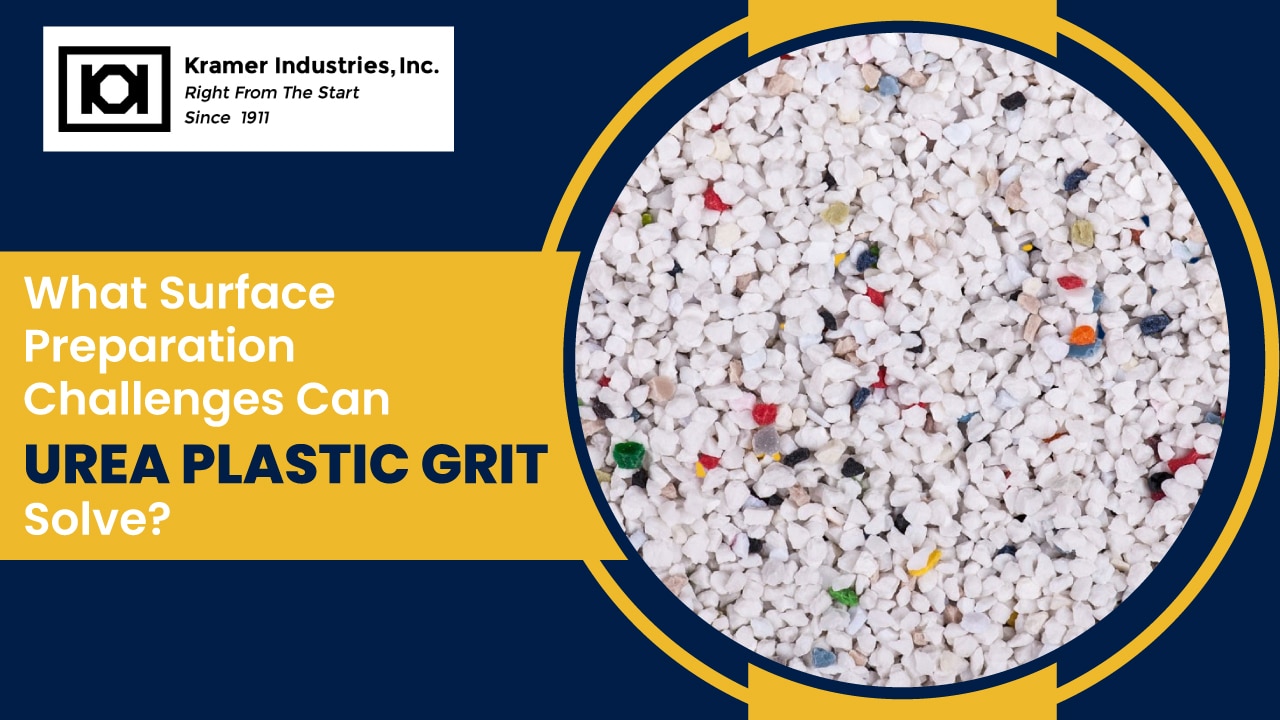
Urea plastic grit provides a controlled abrasive blasting option for these applications. Also known as Type II urea plastic abrasive grit, it is a thermoset plastic media designed primarily for coating removal and surface cleaning rather than aggressive surface profiling.
At Kramer Industries, we understand that choosing the right blasting media can help manufacturers achieve effective coating removal while preserving the condition and dimensions of the underlying component.
What Is Urea Plastic Grit?
Urea plastic grit is an angular plastic abrasive used for controlled abrasive blasting applications. Compared with harder mineral abrasives, it provides less aggressive cutting action, making it useful when the goal is to remove coatings or contaminants without significantly altering the substrate.
Kramer Industries identifies Urea Type II as one of its plastic abrasive media options, alongside Melamine Type III and Acrylic Type V. Urea Type II has an angular shape and a hardness range of approximately 54-62 Barcol.
The performance of urea plastic grit depends on factors such as:
- Particle size
- Blasting pressure
- Nozzle size and condition
- Nozzle distance
- Blast angle
- Coating type
- Substrate material
Matching these variables to the application helps achieve effective stripping while reducing unnecessary substrate damage.
Challenge 1: Removing Coatings Without Damaging the Substrate
One of the biggest challenges in abrasive blasting is removing a coating without excessively affecting the material underneath.
Hard abrasives such as aluminum oxide can provide aggressive cutting action, which is useful for applications requiring heavy material removal or surface profiling. However, that level of aggression may be unsuitable when dimensions, surface geometry, or the original finish must be preserved.
Urea plastic grit provides a more controlled approach. Its particles can mechanically attack the coating while reducing the impact on the underlying substrate compared with many harder abrasives.
This makes it useful when coating removal and substrate protection are equally important.
Challenge 2: Stripping Aluminum and Other Softer Metals
Aluminum and other relatively soft metals can present particular blasting challenges. Coatings may need to be completely removed, but excessive abrasive action can alter the surface or affect critical dimensions.
Urea plastic grit can be used for selected soft-metal applications where controlled coating removal is required. This can be valuable for precision components, tooling, molds, and other parts where preserving the substrate is important.
The objective is not simply to remove the coating as quickly as possible. The process should remove the unwanted material while keeping the underlying component in the required condition.
Challenge 3: Cleaning Composite and Sensitive Materials
Composite materials can also require a controlled blasting approach. Aggressive abrasive media may damage fiberglass, resin systems, or other sensitive surfaces if the process is not properly controlled.
Urea plastic grit provides another option for coating and contaminant removal from selected composite applications. By controlling media size, blasting pressure, nozzle distance, and blast angle, operators can adjust the process to suit the material.
This can help reduce unnecessary surface damage and minimize additional repair or finishing work.
Challenge 4: Removing Coatings Without Chemical Stripping
Some coating-removal applications rely on chemical stripping. While effective, chemical processes can introduce additional handling, cleaning, disposal, and processing requirements.
Urea plastic abrasive can provide a mechanical alternative for certain coating-removal applications. Dry blasting allows the operator to direct abrasive action to the areas where coating removal is required without immersing the component in a chemical stripping solution.
This can be particularly useful when coating removal needs to be integrated into an existing abrasive blasting operation.
Challenge 5: Controlling Surface Profile
Not every surface preparation application requires an aggressive anchor profile.
When a component is being stripped for inspection, refurbishment, repair, or recoating, excessive surface profiling can create additional finishing requirements. The objective may simply be to remove the existing coating while preserving the original surface condition as much as possible.
Urea plastic grit is well suited to applications where controlled coating removal is more important than aggressive profiling. Its less aggressive cutting action can help limit unnecessary changes to the substrate.
How to Get Better Results With Urea Plastic Grit
Urea plastic grit is not automatically the right choice for every abrasive blasting application. Heavy rust, mill scale, or applications requiring significant surface profiling may require a more aggressive abrasive.
The effectiveness of urea plastic grit also depends on the blasting process. Important variables include:
- Media particle size
- Air pressure
- Nozzle size
- Nozzle distance
- Blast angle
- Media flow
- Coating thickness
- Substrate condition
For a new application, testing a representative area can help determine the appropriate combination of media and operating parameters. Starting with controlled settings and adjusting based on actual results can help prevent unnecessary substrate damage.
When Should You Choose Urea Plastic Grit?
Urea plastic grit is a practical option when coating or contaminant removal is required but protecting the underlying surface is a priority.
It may be suitable for applications involving:
- Aluminum and selected soft metals
- Composite components
- Precision parts
- Molds and tooling
- Paint and coating removal
- Carbon and residue removal
- Refurbishment and maintenance applications
- Surfaces where aggressive profiling is undesirable
The correct media should always be selected based on the substrate, coating, desired result, and blasting equipment.
Conclusion
Urea plastic grit helps solve a common surface preparation challenge: removing unwanted coatings and contaminants without unnecessarily damaging the substrate. Its controlled cutting action makes it useful for selected aluminum, composite, precision, tooling, and other sensitive applications where conventional mineral abrasives may be too aggressive.
Successful results depend on more than selecting the media. Particle size, pressure, nozzle condition, blasting distance, angle, coating characteristics, and substrate material all influence the final result.
Kramer Industries provides Urea Type II plastic abrasive grit along with other plastic blasting media to help manufacturers and finishing professionals select abrasive solutions suited to their specific surface preparation requirements.
Frequently Asked Questions
- What is urea plastic grit used for?
Urea plastic grit is primarily used for controlled abrasive blasting applications such as paint and coating removal, surface cleaning, mold and tooling cleaning, and contaminant removal where protecting the underlying substrate is important.
- Is urea plastic grit suitable for aluminum?
Urea plastic grit can be suitable for selected aluminum applications where controlled coating removal is required. The appropriate media size and blasting parameters should be established based on the specific component and coating.
- Is urea plastic grit less aggressive than mineral abrasives?
Yes. Urea plastic grit generally provides a less aggressive cutting action than harder mineral abrasives, making it useful for applications where minimizing substrate alteration is important.
- How do I choose the right urea plastic grit for abrasive blasting?
Selection depends on the substrate, coating type, required stripping rate, desired surface condition, particle size, blasting equipment, and operating pressure. Testing the process on a representative area can help establish the appropriate parameters.
Related Articles