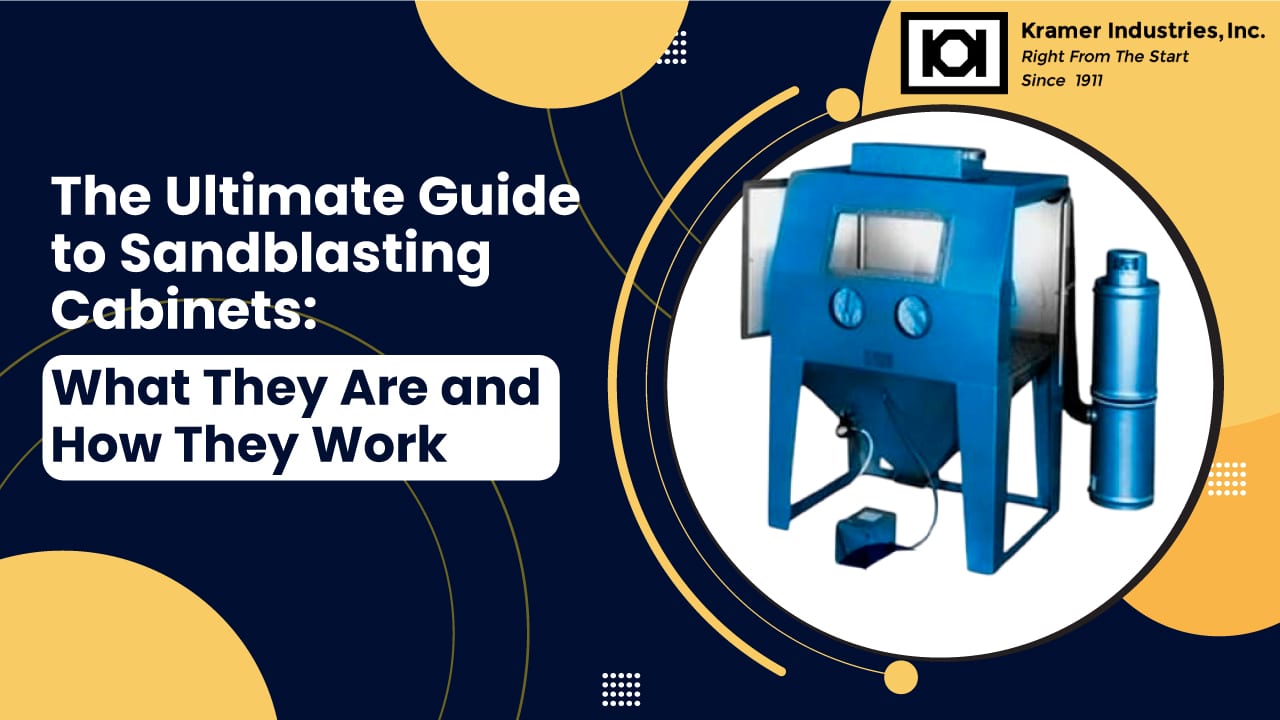
A sandblasting cabinet is an enclosed abrasive blasting system used for cleaning, surface preparation, deburring, etching, and finishing. It propels abrasive media toward a workpiece to remove rust, paint, oxidation, mill scale, and other contaminants while producing a controlled surface finish.
Depending on the application, cabinets may use glass beads, aluminum oxide, steel shot, steel grit, plastic media, walnut shells, or sodium bicarbonate. The right combination of equipment and abrasive helps improve finishing consistency and production efficiency. Explore Kramer Industries’ abrasive media to compare options for different applications.
The Different Types of Sandblasting Cabinets
Common configurations include dry blast cabinets, wet blasting cabinets, micro-abrasive blast cabinets, micro-blasters, micro-jet systems, and shot peening cabinets. Air-blast systems use compressed air, wet-blasting systems introduce water into the process, and wheel-blast systems use a rotating impeller to propel abrasive.
The appropriate system depends on workpiece dimensions, material, required finish, production volume, and abrasive compatibility.
How Sandblasting Cabinet Works
An air-blast cabinet uses compressed air to propel abrasive through a nozzle toward the workpiece. Wet-blasting systems incorporate water, while wheel-blast systems mechanically accelerate abrasive. Particle impact removes contaminants or modifies surface texture.
Moisture in compressed air can cause abrasive clumping and inconsistent media flow. An appropriately sized air-line water separator helps control moisture, although additional air treatment may be necessary depending on operating conditions.
Most industrial sandblasting cabinets use one of the following air-blast configurations.
Dry Blast Cabinets (Air Blast)
Dry blast cabinets use compressed air to propel dry abrasive media. They are commonly used for cleaning, coating removal, deburring, and surface preparation.
Suction Blast Cabinets
Suction blast cabinets use the Venturi principle to draw abrasive into the compressed-air stream. They are often economical and suitable for maintenance, restoration, precision cleaning, and lower-volume production. Performance depends on air capacity, nozzle size, abrasive characteristics, and system condition.
Direct Pressure Blast Cabinets
Direct-pressure cabinets store abrasive in a pressurized vessel and deliver it directly into the blast stream. They can provide higher abrasive throughput and faster cleaning than comparable suction systems, making them useful for demanding industrial applications.
Some systems can handle steel shot or steel grit when designed for those media.
Particle impact energy is described by the formula:
KE=12mv2
Here, m represents particle mass and v represents velocity. Because velocity is squared, increases in velocity can substantially increase kinetic energy. Actual cleaning performance also depends on abrasive shape, hardness, impact angle, and operating conditions.
What a Sandblasting Cabinet Can Do
A sandblasting cabinet supports a range of surface-preparation and finishing operations, including:
- Removing rust, oxidation, mill scale, and old coatings.
- Preparing compatible surfaces for painting, plating, powder coating, or bonding.
- Producing matte, satin, and textured finishes.
- Blending machining marks and removing selected imperfections.
- Deburring machined, stamped, and fabricated components.
- Removing flash from suitable molded plastic and cast parts.
- Performing shot peening on compatible components.
- Etching designs on suitable metal, wood, stone, and glass surfaces.
- Restoring components during maintenance and refurbishment.
Cabinets are used in manufacturing, aerospace, automotive, fabrication, restoration, and industrial maintenance. Oil and grease should generally be removed before blasting because they can spread across the surface and interfere with subsequent coatings.
Choosing the Right Blasting Media
Abrasive selection affects cleaning speed, surface profile, finish quality, and substrate damage. Choose media according to the workpiece material, contaminant, desired result, and cabinet specifications.
Steel Shot and Steel Grit
Steel shot has rounded particles, while steel grit has angular particles. Both can provide effective industrial cleaning in compatible systems. Steel shot is also used in controlled shot peening, while steel grit is often selected for aggressive cleaning and surface preparation.
Glass Beads
Glass beads produce smooth, satin finishes and are used for stainless steel cleaning, aluminum finishing, cosmetic treatments, and precision applications. They can be reused when supported by a suitable recovery system and maintained in good condition.
Aluminum Oxide
Aluminum oxide is a hard, angular abrasive used for paint removal, deburring, and surface preparation. Its durability makes it suitable for repeated use in compatible reclaim systems, although worn or contaminated media must be monitored.
Plastic Media and Walnut Shells
Plastic media and walnut shells provide gentler cleaning for suitable delicate substrates. Applications include selected paint-removal operations, composites, aerospace components, and restoration. Media compatibility should be verified to prevent unwanted surface damage.
Soda Blasting Media
Sodium bicarbonate can remove selected coatings, soot, and contaminants while minimizing damage to suitable underlying surfaces. It is used in some automotive and restoration applications, but residue removal, moisture, and waste handling must be considered.
Selecting the correct abrasive helps achieve the required surface finish, cleaning efficiency, and operating cost.
More Than Just Cleaning: The True Power of a Sandblasting Cabinet
Sandblasting cabinets help manufacturers prepare components for secondary finishing, remove selected imperfections, and improve process consistency. Suitable blasting accessories, including durable nozzles, foot-pedal actuators, and view-window protectors, can support operator control and equipment maintenance.
In aerospace, blasting may prepare approved components for coating or assembly. Automotive and fabrication operations use it to prepare compatible surfaces for painting, powder coating, or plating. Restoration professionals may select gentler abrasives to remove corrosion or coatings while limiting substrate damage.
The required surface cleanliness and profile should follow the coating manufacturer’s instructions and applicable project specifications. Enclosed cabinets help contain abrasive, but appropriate ventilation, dust collection, maintenance, and safe waste handling remain essential. Refer to OSHA abrasive-blasting guidance for workplace safety considerations.
Why Choose Kramer Industries for Your Sandblasting Cabinet?
Choosing a cabinet involves evaluating workpiece size, material, production volume, required finish, abrasive delivery, dust collection, and media recovery.
Kramer Industries offers abrasive-blasting equipment, media, and accessories for various surface-preparation and finishing applications. Matching equipment and consumables to the specific process can help support consistent results and control operating costs.
Contact Kramer Industries to discuss your application and identify a suitable cabinet and abrasive-media combination.
Frequently Asked Questions (FAQs)
- What is a sandblasting cabinet?
A sandblasting cabinet is an enclosed system that uses abrasive media to clean, deburr, etch, remove selected coatings, and prepare surfaces while helping contain abrasive and dust.
- How does a sandblasting cabinet work?
Air-blast cabinets use compressed air to propel abrasive through a nozzle. Wet-blasting systems introduce water, while wheel-blast systems use a rotating impeller. The abrasive impact removes contaminants or modifies the surface.
- What abrasive media can be used in a sandblasting cabinet?
Depending on equipment compatibility, media may include glass beads, aluminum oxide, steel shot, steel grit, garnet, plastic abrasives, walnut shells, silicon carbide, and sodium bicarbonate.
- How much does a sandblasting cabinet cost?
Cost depends on cabinet size, blasting method, air requirements, dust collection, media recovery, automation, and production capacity. Compare total system requirements rather than purchase price alone.
- Can abrasive media be reused in a sandblasting cabinet?
Yes. Compatible recovery systems allow many abrasives to be reused. Inspect media for wear and contamination, and replace it when its condition affects performance or finish quality.
Related Articles