ABRASIVE SANDBLASTING EQUIPMENT
Abrasive Blasting Equipment is used for a wide variety of surface preparation and finishing applications. Portable and Cabinet systems in both Siphon/Suction and Direct Pressure styles provide options for different part sizes, production volumes, and application requirements.
Kramer Industries offers Abrasive Blasting Equipment in an extensive range of sizes and configurations for use with almost any dry abrasive blasting media. These systems can be used for blasting large areas as well as batches of smaller parts.
Siphon/Suction abrasive Sandblasting Equipment is ideal for lower-volume applications where cost is a factor. Direct Pressure systems are typically heavy-duty and designed for quicker abrasive blasting and more regular usage. Portable systems are useful when blasting needs to be performed on the job site or when the part is too large for a cabinet.
Benefits
- Quick and Efficient Surface Modification
- Portable and Cabinet Systems For a Variety of Abrasive Blasting Applications
- Both Economical and Heavy Duty Systems
- Large and Small Parts Processing
- Manual, Semi-Automated and Fully-Automated Options Available
- Continuous Processing; Flow-Through Production
Applications
- Surface Preparation For Coating
- Peening
- Cleaning
- Stripping
- Scale Removal
- Aggressive Abrasive Blasting
- Deflashing
- Rust Removal
Typical Uses
- Surface Prep For Coatings Application
- Machine Mark Removal
- Rust Removal and Cleaning
- Auto and Truck Restoration
- Building and Bridge Blasting
Siphon blast cabinets and pressure blast cabinets are the two main types of abrasive sandblasting cabinets that exist on the market. The two have some distinct differences in how they operate. A siphon/suction abrasive blasting cabinet is mostly used for light production and general cleaning of parts and objects.
A siphon blaster works by using a suction gun with an air jet to pull blast media through a hose and deliver that media to a blast nozzle, where it is then propelled at high speed into the cabinet. Siphon abrasive sandblasting equipment is easier to set up, but it takes more blasting pressure to achieve maximum abrasive impact. Because of this, suction abrasive blasting cabinets will leave a less pronounced anchor pattern than a direct pressure cabinet using the same blast media.
A pressure sandblasting cabinet uses a pressurized vessel (like a pressure pot) filled with blast media, which forces the media through a blast nozzle. Pressure sandblasting is significantly faster and more aggressive than suction sandblasting.
An abrasive sandblasting machine is equipment that uses pressure blasting techniques to clean rust, paint, and other kinds of contamination from metallic parts. The main use of an abrasive blasting machine is to clean metals that are used in the construction industry, ships, etc.
Portable abrasive sandblasting equipment is used worldwide in a variety of applications. Whether it’s offshore, marine, civil, general engineering, and maintenance, or building and stone cleaning, Portable blasting equipment typically uses a pressure blasting technique; however, many hobbyists and DIYers use small, hand-help siphons and gravity blasters.
Advanced Features and The Newest Technology in Blasting Equipment
The cutting-edge sandblasting technology in the blasting systems at Kramer Industries provides unrivaled precision and control. State-of-the-art media recovery systems, precise control valves, and high-efficiency particulate air (HEPA) filters guarantee operations that are both safe and environmentally friendly. Additionally, the integration of IoT technology enables the monitoring and adjustment of processes in real-time, ultimately enhancing both performance and safety.
Customization and Adaptability
Kramer Industries has created specialized blasting systems that are tailored to various industry needs. Clients have the option to choose from several alterations to personalize according to their requirements. Some of these items are turntables, track systems, and specialized grips for handling fragile and irregularly shaped items. The machines are built to be flexible in order to process various kinds of abrasive materials.
They are capable of efficiently managing materials like glass beads, aluminum oxide, silicon carbide, and steel grit to fulfill particular surface treatment requirements.
Factors Related to the Environment
Kramer Industries is committed to environmentally responsible management. Our systems are designed in a way that reduces waste generation and minimizes the environmental effects of blasting operations. Employing advanced filtration systems helps trap dust and recycle fine particulate abrasives, resulting in a significant reduction in material usage and airborne particle emissions.
We are dedicated to following rigorous environmental regulations to ensure that all equipment not only meets but exceeds, industry standards for emissions and waste control.
Enhanced Operator Protection
The main priority in the design of all Kramer Industries blasting systems is operator safety. Our cabinets and portable systems come equipped with robust safety features, including emergency shut-off valves, sealed glove ports, and impact-resistant glass viewing windows. The design incorporates ergonomic features to reduce operator fatigue during long periods of use, such as incorporating adjustable workstations and foot pedal controls.
Industries Catered To
Kramer Industries provides multifunctional abrasive blasting equipment. It is capable of catering to different sectors. They are frequently utilized in the restoration of cars and the maintenance of boats. Furthermore, our technologies are used in the aerospace sector to clean and prepare surfaces of aviation parts with precision. Our blast systems offer a mild but efficient cleaning option for delicate circuit boards and components in the electronics sector.
They make sure there is no danger present. Our subtle media choices and accurate controls play a significant role in the fields of art restoration and architectural preservation. They enable the secure cleaning and refurbishment of historical materials.
Investigating Potential Opportunities and Developments
Kramer Industries is dedicated to advancing abrasive blasting technology. We have put extensive work into research and development. The main emphasis is to enhance automation. The objective is to develop more intelligent, autonomous systems that can adjust to various blasting conditions and needs without the need for human involvement. These advancements will result in improved productivity. They will contribute to the continued effectiveness and financial feasibility of blasting methods in the long run.
Types of Abrasive Blasting Equipment
Different types of Abrasive Blasting Equipment are available for different applications and production requirements:
- Suction Blasting Cabinets – suitable for light production and general cleaning
- Direct Pressure Cabinets – designed for faster and more aggressive blasting
- Portable Pressure Systems – suitable for large parts and job-site applications
- Tumble Blasting Systems – designed for batch processing of smaller parts
- Blast Room Systems – suitable for larger parts and contained industrial blasting
The right system depends on the size and material of the parts, production volume, abrasive media, required blasting pressure, and desired surface finish.
Choosing the Right Blasting Equipment
Choosing the right Abrasive Blasting Equipment starts with understanding the part, application, and desired result. Smaller parts and lower-volume applications may be suitable for cabinet systems, while larger parts or job-site applications may require portable systems.
The abrasive media should also be compatible with the equipment and application. Different media have different hardness, size, shape, and cutting characteristics, so selecting the equipment and media together can help achieve the required surface result.
Before selecting Abrasive Blasting Equipment, consider:
- Size and shape of the parts
- Part material
- Production volume
- Type of surface contamination
- Required surface preparation
- Abrasive media
- Required blasting pressure
- Cabinet or portable operation
- Manual or automated processing
- Dust collection and media recovery requirements
Abrasive blast systems can also be customized with features such as specialized work areas, turntables, track systems, media recovery, and dust collection to support specific processing requirements.
A sand blasting machine can be used for cleaning rust, removing paint and coatings, preparing surfaces, removing scale, and other surface treatment applications. The machine configuration, abrasive media, pressure, and blasting technique should be selected according to the material and desired result.
Kramer Industries offers Abrasive Blasting Equipment for applications ranging from general cleaning and surface preparation to aggressive coating removal and industrial production.
Are you confused about which Abrasive Blasting Equipment to choose? That’s where Kramer Industries comes in. We’re surface finishing specialists, and we have experts to help you. Contact Kramer Industries today and find the system that fits your exact needs.
Frequently Asked Questions (FAQs)
Q1. What equipment is needed for sandblasting?
A typical sandblasting setup can include a blasting system or cabinet, air compressor, blast hose, nozzle, abrasive media, and appropriate protective equipment. Depending on the application, additional equipment such as dust collection and media recovery may also be required.
Q2. What is used in abrasive blasting?
Abrasive blasting uses compressed air or another blasting method to propel abrasive media against a surface. Common media include aluminum oxide, glass beads, silicon carbide, steel grit, steel shot, plastic media, and other materials selected according to the surface and desired result.
Q3. What is the difference between abrasive blasting and sandblasting?
Abrasive blasting is the broader process of using abrasive media to clean, strip, prepare, or finish a surface. Sandblasting is commonly used as a general term for this process, although modern abrasive blasting can use many different media instead of traditional sand.
Q4. What is the difference between suction and pressure blasting?
Suction or siphon systems use an air jet to draw abrasive media into the blast stream, while pressure systems use a pressurized vessel to propel the media. Suction systems are generally suited to lighter applications, while pressure systems provide faster and more aggressive blasting.
Q5. What is the difference between a pressure blast cabinet and a suction blast cabinet?
A pressure blast cabinet uses a pressurized vessel to force abrasive media through the blast nozzle, while a suction cabinet uses an air jet to draw media into the blast stream. Pressure systems generally provide faster, more aggressive blasting, while suction systems are commonly used for lighter-duty cleaning and finishing applications.
Blasting Systems Products:
Showing all 8 results
-

PPB Series – Industrial Grade, Portable Pressure, Abrasive Blasting System
Price range: $11.79 through $1,615.07 Learn MoreThe PPB Series is an economical, Industrial Portable Sandblaster Blasting System designed for industrial applications of all kinds. These systems can be used with a wide variety of dry abrasive blast media and are engineered for ease of use and portability.
-
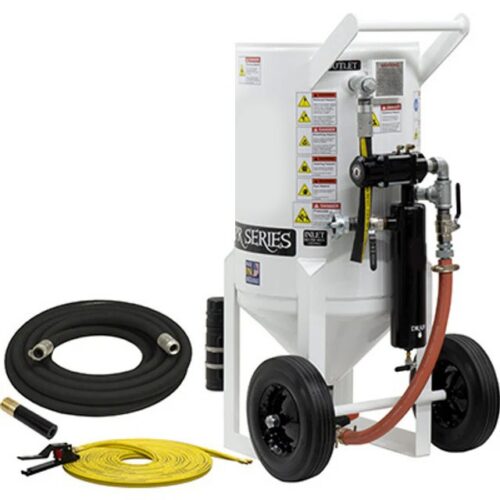
FPB Series Commercial Portable Abrasive Blasters
$3,895.00 Learn MoreThe DB Series is ideal for shorter cycle times and for those new to mass finishing. Two different sizes are available for large and small batch sizes. Economical and durable, the DB Series are one of our most popular vibratory tumblers.
-

BRP Series – Industrial Grade, Direct Pressure, Blast Room Package, Abrasive Blasting System
$19,950.00 Learn MoreThe BRP Series is an economical way to convert any area into a quasi-Blast Room. The convenience of a Blast Room without the high cost associated with building one is the major benefit of this system. This industrial sandblaster system includes a High Capacity Pressure Pot, Sweep-In Media Recovery System, Media Abrasive Separator, and Dust Collector.
-

TB Series – Industrial Grade, Tumble Blast, Abrasive Blasting System
$4,395.00 Learn MoreThe Industrial Tumble Blaster TB Series are enclosed, Suction System Cabinet Blast Systems. The slowly rotating basket is ideal for getting a uniform finish on quantities of small parts. Batch processing of parts can be completed automatically with minimal operator involvement. Multiple capacities are available for processing different part sizes and quantities.
-

SS Series – Industrial Grade, Suction Style, Abrasive Media Blasting Cabinet
$995.00 Learn MoreThe SS Series, Industrial Suction Sandblaster Cabinet is the most economical and commonly used blast cabinet. Designed for small shops and light production areas, the siphon/suction systems are ideal for quick blasting and surface prep. The SS Series can be used with all types of dry abrasive blast media.
-

HDP Series Heavy Duty Cabinets | Heavy Duty Direct Pressure, Abrasive Blasting Cabinet System
$17,995.00 Learn MoreThe HDP Series, Heavy Duty Blasting Cabinets are designed for large shops and when high volume blasting is required. These highly customizable systems can be upgraded and modified to meet specific applications and requirements. A standard exterior track allows easy part loading and unloading. The HDP Series is our most productive blast system.
-

DP Series – Industrial Grade, Direct Pressure, Abrasive Blasting Cabinet System
$4,595.00 Learn More The DP Series, Industrial Blasting Cabinets are efficient and productive systems. Designed for small and large shops, these direct pressure systems are ideal for large quantities of blasting or when efficiency and shorter blasting times are required. The DP Series can be used with all types of dry abrasive blast media.
 -

HDPPB Series – Heavy-Duty Grade, Portable Pressure, Abrasive Blasting System
$4,995.00 Learn MoreThe HDPPB Series is a Contractor Grade, Portable Pressure Blasting System designed for Heavy Duty Portable Sandblaster industrial applications of all kinds. Productivity and safety are engineered into the design of these systems.