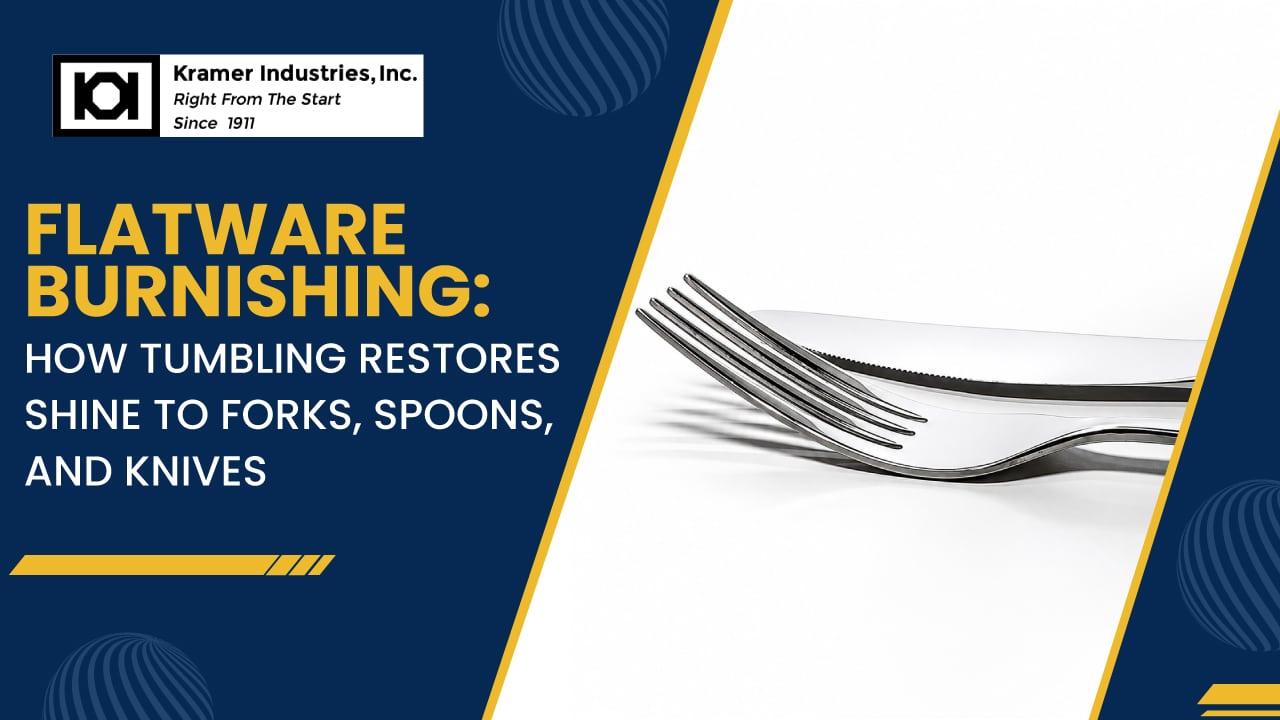
Flatware in restaurants, hotels, and catering operations goes through frequent washing and handling. Over time, forks, spoons, and knives can lose their shine and develop a dull or cloudy appearance. Replacing them can be expensive, while manually polishing large quantities requires considerable time and labor. Flatware burnishing offers a practical way to improve the appearance of suitable utensils. Using appropriate tumbling equipment, stainless steel media, water, and a compatible polishing compound, businesses can restore brightness more efficiently. Kramer Industries provides mass finishing equipment, tumbling media, and finishing compounds for industrial applications.
What Is Flatware Burnishing and How Does It Work?
Flatware burnishing is a mass finishing process that improves the surface appearance of metal utensils. Unlike abrasive polishing, which removes material through a cutting action, it uses smooth, dense media to apply repeated pressure against the metal surface.
During wet tumbling, flatware moves alongside stainless steel media, water, and a suitable compound. Repeated contact helps smooth microscopic surface irregularities, producing a brighter and more uniform appearance.
The process can improve dullness and light surface wear. However, it cannot replace missing silver plating, remove deep gouges, or repair pitting. Understanding these limitations helps determine whether tumbling is suitable before processing an entire batch.
Rotary Tumbling vs. Vibratory Finishing for Flatware
The choice of finishing equipment affects how utensils move, how media contacts their surfaces, and how efficiently batches can be processed.
Rotary Barrel Tumbling
Rotary tumbling uses a rotating barrel to move flatware and finishing media together. As the barrel turns, its contents lift and tumble, creating repeated contact between the media and utensil surfaces.
This method can work well for controlled batch processing. However, barrel speed, loading volume, and the media-to-part ratio influence the results. Overloading can restrict movement and reduce finishing consistency.
Vibratory Finishing
Vibratory equipment uses vibration to circulate flatware and media within a finishing bowl or tub. This movement creates repeated contact across the utensil surfaces.
Equipment size and weight capacity are important considerations, particularly when processing dense stainless steel media. The machine must accommodate the combined weight of the media, water, compound, and flatware.
Both methods can be effective. Testing a small batch helps determine which approach best suits the utensils, equipment, and production requirements.
How to Remove Tarnish From Silverware Using Tumbling
The material being processed matters. Silver and silver-plated flatware can develop tarnish, while stainless steel utensils may show staining, corrosion, or surface discoloration.
Tumbling can improve the appearance of suitable silverware, but it should not be treated as a universal tarnish-removal solution. Heavy tarnish may require separate treatment before processing. Silver polish can also remove some surface material, so repeated polishing should be approached carefully, particularly with plated items.
Antique flatware, utensils with loose handles, and pieces with decorative or delicate materials require additional attention. Knife handles deserve particular care because their construction and materials may not be suitable for wet tumbling.
Before processing, identify the flatware material and assess its condition. This helps prevent damage and ensures the selected finishing method is appropriate. For flatware burnishing operations, a small test batch can help confirm that the process suits the utensils.
Choosing the Right Media and Polishing Compound
Media and compound selection play an important role in achieving a consistent finish. Smooth stainless steel media provides the repeated surface contact needed for burnishing. Its size and shape should suit the utensils being processed.
Media that is too large may not reach smaller details, while unsuitable dimensions can become lodged between fork tines or around other narrow features. Media should also be clean and polished to help prevent unwanted contamination and inconsistent results.
A compatible Polishing Compound supports the wet finishing process. Different mass finishing compounds are developed for different applications, so the choice should reflect the flatware material and desired finish. Suitable Finishing Compounds should also be compatible with the selected media and operating conditions.
Some mass finishing compounds are designed for particular finishing requirements, making it important to check supplier recommendations before selecting a product. Finishing Compounds should be chosen according to the material being processed rather than simply using the same formula for every batch.
Using the correct compound concentration and water level helps maintain consistent processing conditions. Select mass finishing compounds that suit the application, and confirm compatibility before treating valuable or delicate utensils. Comparing available Finishing Compounds can help identify an appropriate option for the required surface result.
How to Maintain Consistent Results
Good process control is essential when finishing large batches of commercial flatware. The following practices can help improve consistency:
- Clean utensils first: Remove food residue and other contamination before tumbling.
- Inspect the media: Use clean, polished media in suitable dimensions.
- Control loading: Avoid overfilling the equipment so flatware and media can circulate freely.
- Maintain compound concentration: Follow the supplier’s guidance for mixing and application.
- Monitor cycle time: Check results periodically rather than assuming longer processing will always produce a better finish.
- Inspect after processing: Look for lodged media, uneven brightness, and signs of damage.
After tumbling, rinse the utensils thoroughly and follow appropriate cleaning and sanitising procedures. A bright finish does not automatically mean a utensil is clean or ready for food contact.
For restaurants, hotels, and catering businesses, consistent processing can help maintain reusable flatware while reducing the labor associated with manual polishing.
Conclusion
Flatware burnishing provides a practical finishing option for businesses that need to maintain the appearance of frequently used utensils. By selecting suitable equipment, stainless steel media, and compatible compounds-and controlling loading, cycle time, and cleaning-businesses can achieve more consistent results. Testing a small batch first helps confirm that the process is appropriate before moving to larger production runs. Kramer Industries can help businesses explore mass finishing solutions for their application.
Frequently Asked Questions
-
What is flatware burnishing used for?
It improves the brightness and surface appearance of suitable metal utensils, including forks, spoons, and knives. The process uses smooth media and repeated contact to reduce minor surface dullness and irregularities.
-
Can tumbling remove tarnish from silver-plated flatware?
Tumbling may improve the appearance of suitable silver-plated flatware, but heavy tarnish may require separate treatment. It cannot restore missing plating or repair deep surface damage.
-
Which is better for silverware polishing: rotary tumbling or vibratory finishing?
Both methods can produce effective results. Rotary tumbling uses a rotating barrel, while vibratory finishing circulates the parts and media through vibration. The best option depends on batch size, equipment capacity, utensil design, and finishing requirements.
-
What does a polishing compound do during flatware finishing?
A polishing compound supports the wet tumbling process and helps achieve the desired surface finish. Its suitability depends on the flatware material, media, and finishing requirements.
-
Where can businesses find flatware finishing equipment and compounds?
Kramer Industries offers mass finishing equipment, tumbling media, and finishing compounds for metal finishing applications. The appropriate solution depends on the flatware material and production requirements.
Related Articles