Stainless steel is widely valued for its strength, corrosion resistance, and clean appearance, making it a preferred material in industries such as medical device manufacturing, food processing, aerospace, and automotive production. However, achieving a high-quality finished part requires more than precision machining. The right surface finishing process plays a critical role in enhancing appearance, improving performance, and preparing components for their intended application.
Selecting the right polishing media for stainless steel is one of the most important decisions in mass finishing. The ideal media depends on the desired finish, part geometry, stainless steel grade, and production requirements. Choosing the appropriate media can improve consistency, reduce processing time, and minimize costly rework.
Start with the Desired Surface Finish
Before selecting polishing media, it’s important to define the finishing objective. Are you removing machining marks, deburring sharp edges, creating a satin finish, or achieving a mirror-like polish?
Each finishing goal requires a different combination of polishing media, finishing compounds, and processing time. Selecting media based solely on cost can lead to inconsistent finishes, longer cycle times, and unnecessary wear. Focusing on the desired outcome helps optimize both quality and efficiency.
Types of Polishing Media for Stainless Steel
Different types of polishing media are designed to achieve specific finishing results. Understanding their characteristics helps manufacturers choose the most effective solution for each application.
Ceramic Media
Ceramic media is ideal for aggressive deburring and surface preparation. It provides excellent cutting action while maintaining a long service life, making it suitable for removing burrs, smoothing machined surfaces, and preparing parts for subsequent polishing operations.
Because of its higher cutting capability, ceramic media is commonly used as the first stage in a multi-step finishing process.
Plastic Media
Plastic media is recommended for delicate or precision-machined stainless steel components that require controlled material removal.
Its softer composition helps smooth surfaces and blend minor imperfections while maintaining tight dimensional tolerances. Plastic media is often used for thin-walled parts or components where excessive cutting must be avoided.
Porcelain Media
Porcelain media is commonly used after deburring to refine the surface and produce a bright, high-luster finish.
Unlike abrasive media, porcelain primarily smooths the existing surface rather than removing significant amounts of material. It is an excellent choice for decorative finishes and components requiring an enhanced cosmetic appearance.
Stainless Steel Media
For applications requiring maximum brightness, stainless steel media is often the preferred solution.
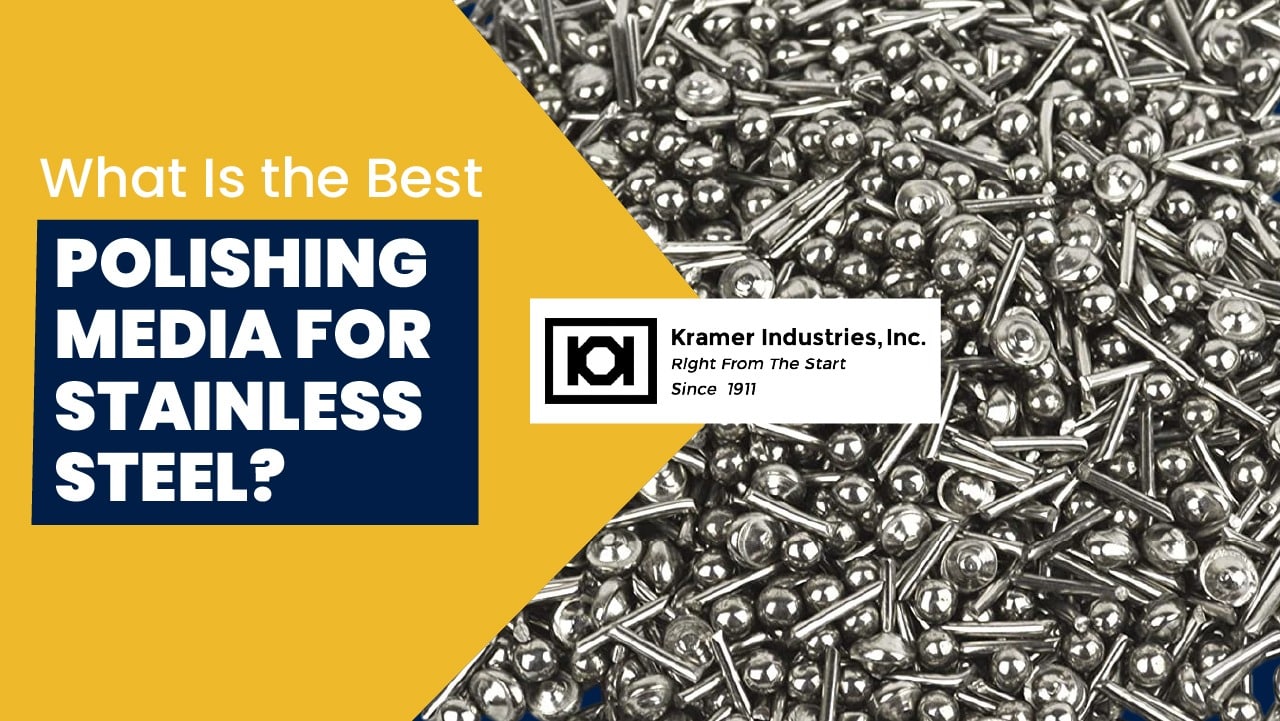
Available in shapes such as balls, pins, and diagonals, stainless steel media burnishes rather than cuts the surface. The process compresses microscopic surface irregularities to create a smooth, mirror-like finish while minimizing contamination risks. This makes it particularly suitable for medical devices, food processing equipment, and other applications requiring high levels of cleanliness.
Organic Media
Organic media, including corn cob and walnut shell, is typically used during the final drying and polishing stages.
Although it performs very little material removal, organic media helps remove residual moisture while enhancing surface appearance. When used with specialized polishing compounds, it provides the final touch for achieving a clean, attractive finish.
Factors to Consider When Choosing Polishing Media
Selecting the best polishing media for stainless steel involves more than choosing a media type. Several additional factors influence finishing performance, including:
- Stainless steel grade and hardness
- Part size and geometry
- Required surface finish
- Processing time
- Dimensional tolerances
- Finishing compounds
- Production volume
Complex components with blind holes or intricate features may require specialized media shapes to ensure all surfaces are properly finished. Likewise, selecting the right finishing compound helps improve lubrication, suspend removed material, reduce staining, and enhance overall polishing performance.
Testing different media and process combinations on a small production batch is often the most effective way to optimize finishing results before full-scale manufacturing.
Conclusion
The best polishing media for stainless steel depends on the specific finishing requirements of your application. Ceramic media is ideal for aggressive deburring, plastic media offers controlled finishing for precision components, porcelain media enhances surface appearance, stainless steel media creates brilliant mirror finishes, and organic media provides the final polishing touch. Selecting the right combination of media, compounds, and process parameters helps manufacturers achieve consistent, high-quality surface finishes while improving productivity and reducing rework.
Kramer Industries offers a wide selection of polishing media for stainless steel, along with mass finishing equipment and application expertise to help manufacturers achieve the ideal surface finish for every production requirement.
Frequently Asked Questions
1. What is the best polishing media for stainless steel?
The best polishing media for stainless steel depends on the desired finish. Ceramic media is best for deburring, plastic media is suitable for precision parts, porcelain media creates high-luster finishes, stainless steel media produces mirror-like finishes, and organic media is commonly used for final polishing and drying.
2. Can stainless steel media create a mirror finish?
Yes. Stainless steel media is specifically designed for burnishing rather than material removal. It compresses the surface to reduce microscopic imperfections, producing a bright, mirror-like finish while minimizing the risk of contamination.
3. How do I choose the right polishing media for stainless steel parts?
The right polishing media depends on factors such as the stainless steel grade, part geometry, required surface finish, dimensional tolerances, and production volume. Evaluating these factors and testing the finishing process can help achieve the best results.
Related Articles