Abrasive blasting often comes down to a balancing act. You need enough impact to remove rust, scale, paint, and other surface contamination, but not so much aggression that the blasting process damages the part underneath. This becomes especially important with thinner, softer, or dimensionally sensitive metal components.
Nu-Soft Steel Shot is designed for applications where conventional hardened steel shot may be more aggressive than necessary. Its lower hardness allows the media to clean effectively while producing a less aggressive impact on the workpiece. For the operator, that can mean better control over the finished surface and less risk of damaging valuable parts. Kramer Industries offers abrasive media options for applications where controlled cleaning is important.
Why Does Nu-Soft Steel Shot Work Better for Delicate Metal Parts?
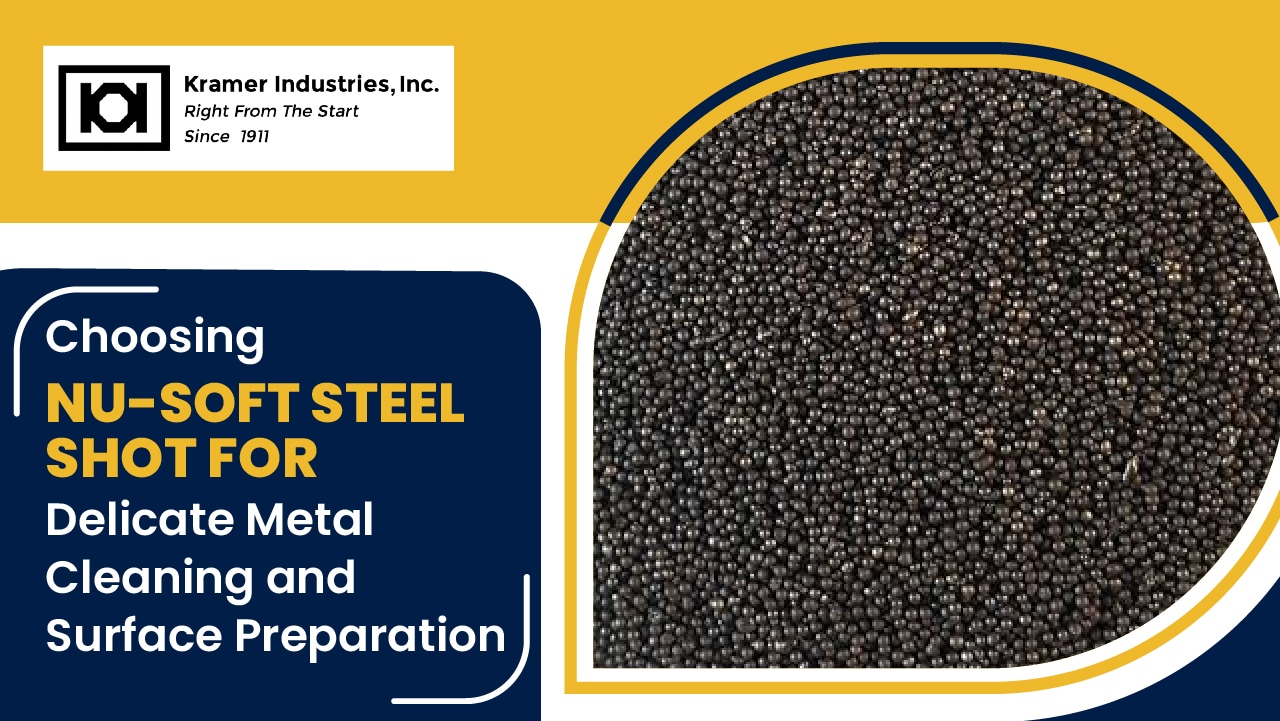
Steel shot cleans primarily through repeated impact. Thousands of spherical particles strike the surface at high velocity, knocking away contamination and altering the surface of the underlying metal.
With harder Steel Shot, those impacts can be highly effective, but they can also be too severe for certain applications. Thin sheet metal, softer alloys, castings with delicate features, and components requiring close dimensional control may need a more forgiving blasting process.
Nu-Soft Steel Shot provides that middle ground. Because the shot is softer, it tends to produce a gentler impact than harder Steel Shot under comparable blasting conditions. This gives operators an effective metallic abrasive without automatically subjecting the part to the same level of surface aggression.
That does not mean Nu-Soft Steel Shot cannot clean effectively. Air pressure, wheel speed, media size, exposure time, angle of impact, and stand-off distance still determine how much energy reaches the surface. The advantage is that the softer shot provides another way to control the process.
For shops handling higher-value or more sensitive components, that additional control can help reduce:
- Rejected parts
- Excessive surface alteration
- Unnecessary rework
Which Nu-Soft Steel Shot Size Should You Use?
Selecting the correct Nu-Soft Steel Shot size depends on what you are removing and the condition of the part underneath.
Larger shot carries more mass and delivers greater impact energy. That makes coarser sizes better suited to applications involving heavier rust, mill scale, or stubborn coatings. When cleaning speed is the priority and the component can tolerate stronger impact, moving toward a larger shot size can improve productivity.
Smaller shot produces lighter individual impacts and provides more strikes over a given area. This generally makes finer Nu-Soft Steel Shot a better starting point for:
- Lighter cleaning
- Thinner coatings
- Smaller components
- Intricate geometries
- Applications where surface preservation is especially important
Paint removal often falls somewhere between these two conditions. A thin or poorly bonded coating may respond well to finer shot, while multiple coating layers or strongly adhered industrial finishes may require a larger size or more aggressive operating parameters.
The key is not to select shot size based solely on how quickly it removes the contaminant. The goal is to find the smallest and least aggressive combination that achieves the required cleaning rate and finished surface. Whenever possible, test the process on a representative part before committing to production.
How Does Nu-Soft Steel Shot Affect Surface Finish?
The hardness of Steel Shot influences more than cleaning performance. It also affects what happens to the substrate after the contamination is removed.
Harder Steel Shot transfers impact energy efficiently and can create a more pronounced effect on the metal surface. That may be desirable when aggressive cleaning or a particular surface condition is required. On a delicate component, however, excessive impact can alter the finish more than intended.
Nu-Soft Steel Shot offers greater control when the objective is to clean while limiting that aggressive surface effect. Its spherical shape also produces a different finish than angular steel grit, which cuts into the surface rather than primarily impacting it.
This distinction matters when the blasted component will be inspected, coated, machined, assembled, or used without additional finishing. A blasting process should not simply leave a part “clean.” It should leave the surface in the correct condition for whatever comes next.
Nu-Soft Steel Shot Abrasives for Controlled Surface Treatment
Nu-Soft Steel Shot Abrasives fill an important gap between effective metallic blasting and controlled surface treatment. Their lower hardness makes them particularly useful for cleaning delicate metal parts where conventional hardened Steel Shot may be unnecessarily aggressive.
Choosing the right size is equally important. Finer sizes favor controlled cleaning and surface preservation, while larger sizes provide more impact for scale, rust, and heavier coating removal.
Steel Shot Blasting for Delicate Metal Components
Steel Shot Blasting should be approached as a controlled cleaning process when working with delicate components. Pressure or wheel speed, exposure time, shot size, impact angle, and stand-off distance can all influence the final result.
Using conservative parameters and testing a representative part can help establish an effective Steel Shot Blasting process without applying more energy than necessary. Kramer Industries recommends considering the media and operating conditions together when selecting an abrasive process.
Conclusion
Nu-Soft Steel Shot fills an important gap between effective metallic blasting and controlled surface treatment. Its lower hardness makes it particularly useful for cleaning delicate metal parts where conventional hardened Steel Shot may be unnecessarily aggressive.
Choosing the right Nu-Soft Steel Shot size is equally important. Finer sizes favor controlled cleaning and surface preservation, while larger sizes provide more impact for scale, rust, and heavier coating removal. Combined with proper pressure, exposure time, and equipment settings, the right shot size can deliver efficient cleaning without sacrificing the integrity of the workpiece.
For operators trying to improve abrasive blasting consistency, the best media is not always the hardest or most aggressive. It is the media that removes what needs to come off while leaving the underlying metal exactly where you want it. Kramer Industries can be considered when evaluating abrasive media for these application requirements.
Frequently Asked Questions
- What is Nu-Soft Steel Shot used for?
Nu-Soft Steel Shot is used for cleaning and surface treatment of soft, thin, delicate, or dimensionally sensitive metal components where conventional hardened Steel Shot may be unnecessarily aggressive.
- Is Nu-Soft Steel Shot less aggressive than regular Steel Shot?
Yes. Its lower hardness provides a less aggressive impact under comparable blasting conditions. However, pressure, wheel speed, shot size, and exposure time still affect the overall blasting intensity.
- How do you choose the right Nu-Soft Steel Shot size?
Choose the size based on the contaminant, substrate, required cleaning rate, and acceptable surface impact. Finer sizes are generally better suited to lighter cleaning and sensitive parts, while larger sizes provide greater impact for heavier contamination.
- What is the difference between Steel Shot and steel grit?
Steel Shot is spherical and primarily cleans through repeated impact, while steel grit is angular and cuts into the surface more aggressively. The choice depends on the required cleaning action and desired surface condition.
- How can you prevent damage during Steel Shot Blasting?
Use an appropriate shot size and control pressure or wheel speed, exposure time, impact angle, and stand-off distance. Testing the process on a representative part before production can help confirm that the required cleaning is achieved without excessive surface alteration.
Related Articles