In surface preparation, consistency and efficiency are essential. Whether the objective is removing heavy scale, stripping coatings, or preparing parts for coating or bonding, the blasting method directly affects throughput, finish quality, and operating cost. A pressure blasting machine is designed for demanding applications where speed, control, and repeatable performance are critical. Understanding how these systems operate helps manufacturers and fabricators select equipment that supports reliable production outcomes, an area where Kramer Industries evaluates equipment performance in real-world finishing environments.
What Is a Pressure Blasting Machine?
A pressure blasting machine is an abrasive blasting system that propels media using compressed air from a sealed, pressurized vessel. Unlike suction or siphon systems that rely on vacuum to draw abrasive into the airstream, a pressure blasting machine forces media out under pressure. This delivery method produces higher media velocity and more consistent flow at the nozzle.
Pressure blasting machines are commonly housed in enclosed blast cabinets or rooms and are used in industrial environments that require aggressive cleaning or surface profiling. Typical applications include steel fabrication, foundry operations, heavy equipment maintenance, and preparation of parts with tough coatings or heavy contamination. These use cases are frequently reviewed by Kramer Industries when matching blasting systems to production demands.
How a Pressure Blasting Machine Works
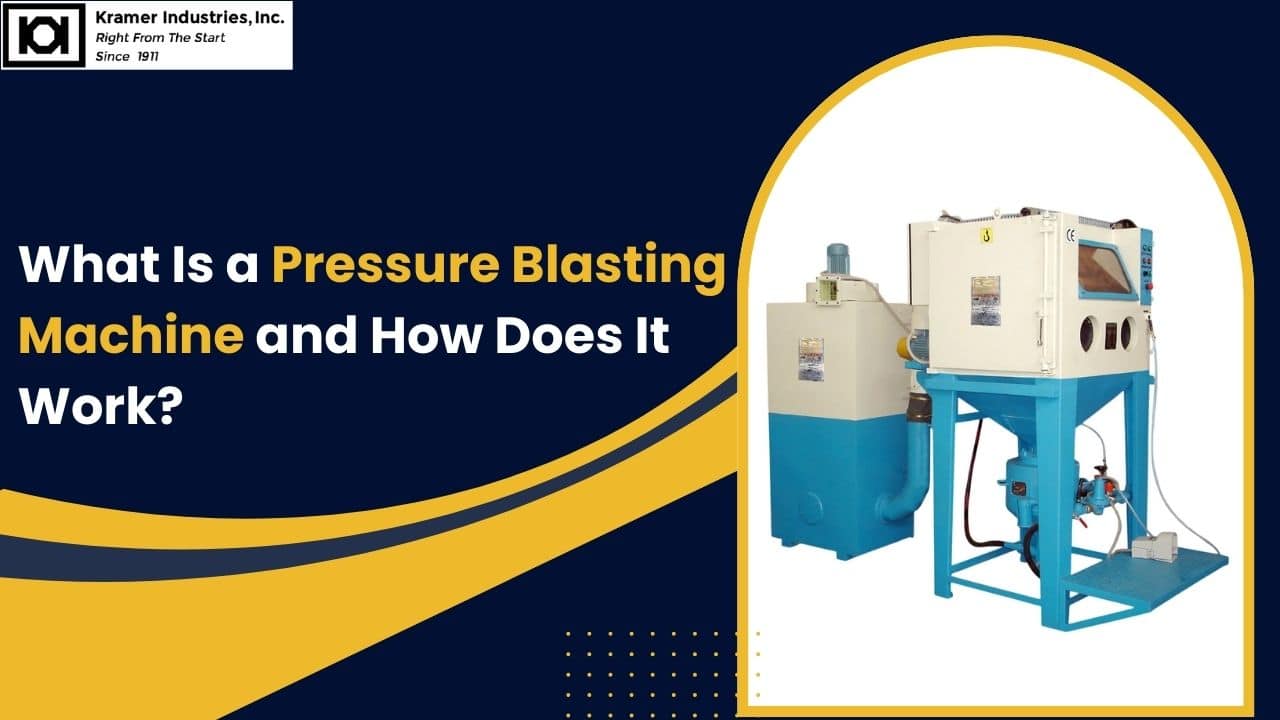
At the center of a pressure blasting machine is a pressure pot filled with abrasive media. When the system is activated, compressed air pressurizes the vessel, pushing the media through a metering valve and into the blast hose. The air and abrasive travel together to the nozzle, where they exit at high velocity and impact the work surface.
Inside a pressure blast cabinet, the operator controls the nozzle through sealed gloves while the enclosure contains dust and rebounding media. Spent abrasive falls to the bottom of the cabinet and is directed into a recovery system. Dust collectors remove fines and debris, maintaining visibility and allowing usable abrasive to be recycled back into the system.
Because the abrasive is already pressurized before reaching the nozzle, media flow remains steady and controllable. This stability allows operators to maintain consistent blast intensity over extended production runs, a performance characteristic often emphasized by Kramer Industries in high-throughput blasting applications.
Pressure Blasting Compared to Suction Systems
The most significant difference between pressure blasting and suction blasting is performance. A pressure blasting machine can deliver significantly higher blasting power than a comparable suction system using the same air supply. This increased energy results in faster cleaning and shorter cycle times.
Pressure systems also handle heavier and more aggressive abrasives more effectively. Media such as steel grit or aluminum oxide can be difficult for suction systems to lift consistently, while pressure blasting machines move them with ease. For applications that require deep surface profiles or rapid coating removal, pressure blasting is often the most practical option.
Benefits for Productivity and Quality
The primary advantage of a pressure blasting machine is productivity. Faster material removal reduces labor time per part and helps eliminate bottlenecks in finishing operations. In high-volume or heavy-duty environments, this efficiency can significantly improve throughput.
Consistency is another key benefit. Controlled media flow produces uniform surface finishes, which is critical for coating adhesion, welding preparation, and bonding applications. A consistent surface profile reduces rework and improves downstream process reliability.
Pressure blasting machines also offer operational flexibility. By adjusting air pressure, abrasive type, and nozzle configuration, operators can tailor the process to different materials and finish requirements. This versatility allows a single system to support a wide range of applications.
While the initial investment is typically higher than for suction cabinets, pressure blasting machines often deliver lower cost per part over time. Improved efficiency, reduced processing time, and better abrasive utilization contribute to a strong return on investment for operations with regular blasting demands.
Common Applications
Pressure blasting machines are widely used for removing rust, mill scale, and heavy coatings from steel components. They are also effective for creating controlled surface profiles prior to thermal spray, powder coating, or epoxy application. In maintenance and repair environments, they support efficient cleaning and refurbishment of worn components, extending service life and improving performance.
Conclusion
A pressure blasting is built for high-performance surface preparation. By delivering abrasive media under pressure rather than relying on suction, it provides faster blasting, greater control, and consistent results across demanding applications. For operations that require aggressive cleaning, reliable surface profiles, and high throughput, pressure blasting offers an efficient and dependable solution.
For manufacturers evaluating blasting equipment and process efficiency, Kramer Industries applies practical surface finishing experience to help ensure pressure blasting systems support productivity, quality, and long-term operational efficiency.
Related Articles